
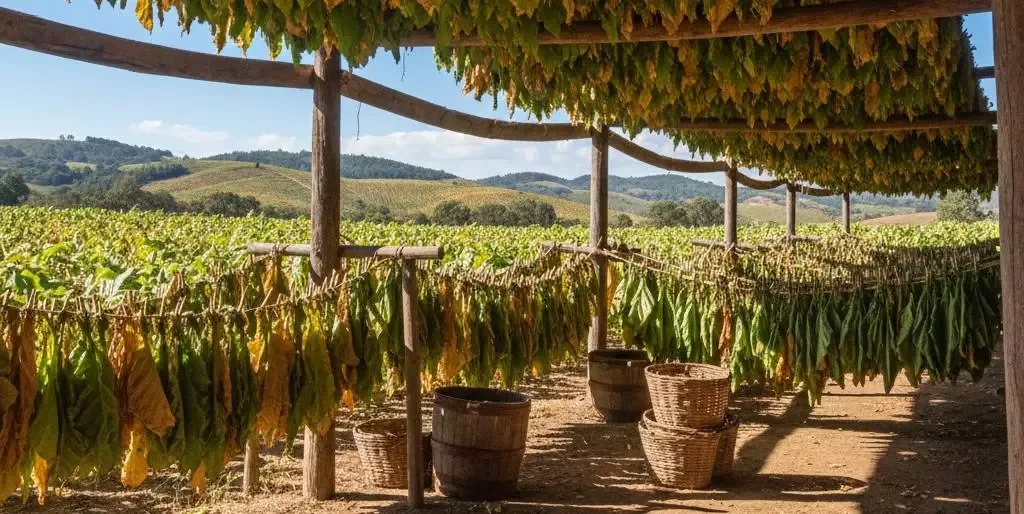
How Tobacco Curing Affects Leaf Quality, Aroma and Cigarette Production
The tobacco curing process is the post-harvest stage that transforms raw leaf tobacco into the stable, aromatic material used in cigarette blends. Curing does more than remove moisture — it drives fundamental chemical changes in the leaf that determine its sugar content, nicotine chemistry, aroma profile, and physical structure. These properties carry through every subsequent stage of production — primary processing, blending, cutting, and ultimately the tobacco feeder and cigarette making machine. Understanding how different curing methods produce different leaf chemistry helps factory buyers and production managers interpret incoming leaf quality and understand how blend changes affect cigarette making machine performance.
What Happens Chemically During Tobacco Curing
When tobacco leaves are harvested they contain high levels of starch, chlorophyll, and moisture. The curing process drives a sequence of chemical reactions that transform these compounds:
- Starches convert to sugars — enzymatic activity during the early stages of curing breaks starch chains into simpler sugars. The extent of this conversion depends on curing temperature and rate — flue curing at controlled temperatures produces high sugar retention while rapid high-heat drying stops the conversion early
- Chlorophyll breaks down — the green pigment in fresh leaf degrades during curing producing the characteristic brown to golden colors of cured tobacco
- Moisture reduces — from 80 to 90 percent in fresh leaf down to 15 to 20 percent in cured leaf — stabilizing the leaf for storage and transport
- Nicotine redistributes — nicotine moves from stems to leaf lamina during curing, increasing the concentration available in the smokeable portion of the leaf
- Aromatic compounds develop — organic acids, esters, and volatile compounds develop during curing producing the characteristic aroma of each tobacco type
The Four Tobacco Curing Methods
| Curing Method | Tobacco Type | Leaf Chemistry | Factory Implication |
|---|---|---|---|
| Flue curing | Virginia | High sugar, moderate nicotine, bright color | High sugar content requires careful conditioning — affects garniture flow and rod weight |
| Air curing | Burley | Low sugar, high nicotine, brown color | Lower sugar leaf flows differently — blend ratio affects feeder setpoint calibration |
| Fire curing | Dark tobaccos | Smoky compounds, strong aroma | Specialty use — rarely used in standard cigarette blends |
| Sun curing | Oriental | Aromatic oils, complex flavor | Low volume blend component — affects aroma profile without major process implications |
Flue Curing — Virginia Tobacco
Flue curing is the most widely used curing method in global cigarette production. Harvested Virginia tobacco leaves hang in sealed barns through which heated air circulates — generated by indirect heat sources that do not allow combustion gases to contact the leaf. The controlled temperature profile drives rapid starch-to-sugar conversion while locking in the bright golden color characteristic of Virginia leaf.
Typical curing duration: 4 to 7 days, depending on leaf position and barn loading density.
Resulting leaf chemistry: High sugar content (up to 20 percent), moderate nicotine, bright golden-orange color, mild aroma.
Factory implication: High-sugar Virginia leaf requires careful moisture conditioning before entering primary processing. The sugar content affects how the leaf cuts and flows through the garniture section — high-sugar leaf can become tacky at high moisture levels, increasing garniture contamination risk. Blend ratios of Virginia-heavy blends require feeder calibration to account for the higher sugar content affecting blend density.
Air Curing — Burley Tobacco
Air curing is used for Burley tobacco — a variety grown primarily in Kentucky, Tennessee, and parts of Europe. Harvested leaves hang in open barns with controlled natural ventilation for several weeks. Without artificial heat, the curing process is slower — the starch-to-sugar conversion is limited and most of the residual sugars are metabolized during the extended curing period, producing the low-sugar character distinctive of Burley.
Typical curing duration: 4 to 8 weeks, depending on weather conditions and barn ventilation.
Resulting leaf chemistry: Low sugar content (under 1 percent), high nicotine, brown color, earthy aroma.
Factory implication: Burley’s low sugar content produces different flow behavior from Virginia in the garniture section. High-Burley blends are typically less tacky and flow more freely — which can cause slight overfeed if the tobacco feeder setpoint was calibrated for a Virginia-dominant blend. Blend ratio changes between Virginia and Burley require feeder recalibration.
Fire Curing — Dark Tobaccos
Fire curing exposes harvested tobacco to controlled open fires within the curing barn — allowing combustion gases and smoke to contact the leaf directly. This produces the distinctive smoky, robust character of dark fire-cured tobacco. Fire-cured tobaccos are not typically used in standard cigarette blends — they appear in specialty products, pipe tobaccos, and chewing tobacco.
Resulting leaf chemistry: Very low sugar, high nicotine, dark brown to black color, strong smoky aroma.
Factory implication: Rarely encountered in standard cigarette production lines. Factories receiving fire-cured leaf should treat it as a specialist material requiring separate handling from Virginia and Burley.
Sun Curing — Oriental Tobacco
Oriental tobaccos are small-leafed aromatic varieties grown primarily in Turkey, Greece, Bulgaria, and surrounding regions. After harvest, the leaves are laid on frames or strings and dried in direct sunlight for several weeks. Sun curing produces a leaf with complex aromatic oil development and a distinctive spicy, herbal character that neither Virginia nor Burley can replicate.
Typical curing duration: 2 to 4 weeks, depending on sunlight intensity and ambient temperature.
Resulting leaf chemistry: Low to moderate sugar, moderate nicotine, small leaf size, high aromatic oil content.
Factory implication: Oriental tobacco is typically used at 5 to 15 percent of the blend — as a flavor modifier rather than a primary filler. Its small leaf size and aromatic oil content affect blend density and cut behavior at high percentages. Standard feeder calibration typically accommodates low Oriental percentages without adjustment.
How Curing Method Affects Cigarette Making Machine Performance
The curing method determines the leaf chemistry that arrives at your factory as cut filler — and leaf chemistry directly affects two critical cigarette making machine parameters: tobacco flow behavior through the feeder and garniture section, and cigarette rod weight consistency. When a blend change shifts the Virginia-to-Burley ratio or introduces a new crop of leaf with different curing characteristics, production managers should recheck the tobacco feeder calibration before running the change at full production speed. For a complete guide to how tobacco feeder calibration affects cigarette rod weight, see our guide to Tobacco Feeder Accuracy: How to Optimize Cigarette Feeding Performance.
Frequently Asked Questions
What is the tobacco curing process?+
The tobacco curing process is the controlled post-harvest drying and chemical transformation of tobacco leaves. It removes moisture while driving chemical changes that determine the leaf’s sugar content, nicotine chemistry, aroma profile, and physical structure. The four main curing methods are flue curing, air curing, fire curing, and sun curing — each producing leaf with different chemical and physical properties suited to different cigarette blend applications.
Why does curing method matter for cigarette production?+
Curing method determines the chemical composition of the leaf that enters primary processing as cut filler. Different curing methods produce leaf with significantly different sugar content, nicotine levels, and physical structure — all of which affect how the filler flows through the tobacco feeder, how it behaves in the garniture section of the cigarette maker, and how blend changes affect cigarette rod weight consistency.
What is the difference between flue-cured and air-cured tobacco?+
Flue-cured tobacco — Virginia — is dried with controlled indirect heat over 4 to 7 days, producing high sugar content, bright golden color, and mild aroma. Air-cured tobacco — Burley — hangs in ventilated barns for 4 to 8 weeks without artificial heat, producing very low sugar content, high nicotine, brown color, and earthy character. These chemical differences mean Virginia and Burley perform differently in the cigarette maker’s garniture section and require different tobacco feeder calibration when blend ratios change.
How does a blend change between Virginia and Burley affect the cigarette making machine?+
Shifting the Virginia-to-Burley ratio in a cigarette blend changes the bulk density and sugar content of the cut filler. High-Burley blends flow more freely through the garniture than high-Virginia blends at the same feeder setpoint — potentially causing overfeed and overweight cigarettes if the feeder is not recalibrated for the new blend. Production managers should recheck feeder calibration whenever a significant blend ratio change is introduced.
Conclusion
The tobacco curing process is where cigarette quality is first determined — before the leaf ever reaches a factory. Curing method determines leaf chemistry, leaf chemistry determines blend behavior, and blend behavior determines how consistently the cigarette making machine produces on-specification cigarettes. Factory buyers who understand the downstream implications of curing method decisions are better positioned to interpret incoming leaf quality data, manage blend changes, and maintain consistent production quality. For a complete guide to how tobacco filler types and blend composition affect cigarette making machine performance, see our guide to What Is Tobacco Filler and How It Shapes Cigarettes. For tobacco machinery suppliers in USA who supply primary processing equipment, see our dedicated suppliers page.



Looking for Cigarette Machinery?
Browse our current inventory of manufacturing, filter making, packing, and wrapping equipment, or send us your target speed and format for a fast quote.