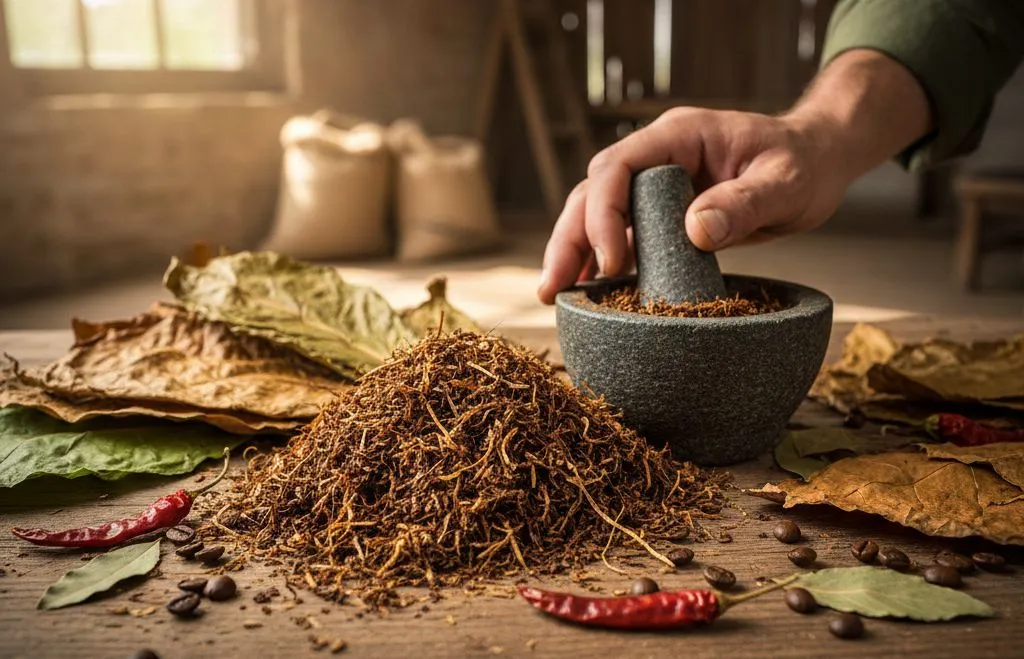
Understanding how tobacco is made from the Nicotiana plant requires following the leaf through five stages — from cultivation and harvest, through curing and fermentation, to the aging and conditioning that prepares it for factory primary processing. All commercial tobacco in cigarettes comes from one species — Nicotiana tabacum — but its three main botanical types produce fundamentally different leaf chemistry depending on which curing method is applied. This guide explains the complete journey from Nicotiana plant to factory-ready cut filler.
The Nicotiana Plant — Commercial Tobacco Species
The genus Nicotiana contains over 60 species but only one — Nicotiana tabacum — is grown at commercial scale for cigarette production. Nicotiana tabacum is not a single uniform plant. It encompasses several distinct botanical types that produce leaf with fundamentally different chemical and physical properties — determined by their genetics, growing environment, and curing method. Understanding which Nicotiana tabacum type produces which leaf chemistry is essential for understanding why cigarette blend specifications exist and why different leaf origins produce different production outcomes. For a complete guide to how leaf chemistry affects cigarette production, see our guide to What Is Tobacco Filler and How It Shapes Cigarettes.
| Nicotiana Species | Common Name | Primary Growing Region | Curing Method |
|---|---|---|---|
| N. tabacum (Virginia type) | Virginia — flue-cured tobacco | USA Southeast, Brazil, Zimbabwe | Flue curing — produces high-sugar, bright leaf |
| N. tabacum (Burley type) | Burley — air-cured tobacco | USA Kentucky and Tennessee, Malawi | Air curing — produces low-sugar, high-nicotine leaf |
| N. tabacum (Oriental type) | Oriental — sun-cured tobacco | Turkey, Greece, Bulgaria | Sun curing — produces aromatic, small-leaf tobacco |
| N. rustica | Wild tobacco — high nicotine | South America, Eastern Europe | Various — primarily for nicotine extraction |
Stage 1 — Nicotiana Plant Cultivation
Commercial Nicotiana tabacum cultivation begins with seedling propagation in controlled nurseries. Seeds are sown in seedbeds or float trays under managed conditions — temperature, moisture, and light — for 6 to 8 weeks until seedlings reach transplanting size. This controlled propagation stage ensures uniform seedling development across large growing areas.
After transplanting, plants are managed through the growing season — irrigation, fertilization, pest and disease control, and the critical management operations of topping and suckering. Topping removes the flower head at the correct growth stage to redirect plant energy into the remaining leaves — increasing their size, thickness, and nicotine content. The topping timing decision is one of the most consequential management actions in the entire cultivation cycle, directly affecting the nicotine content and leaf size of the harvest batch.
- Soil requirements: well-drained, light to medium loam soils — pH 5.8 to 6.5 for most Nicotiana tabacum varieties
- Growing season duration: typically 90 to 120 days from transplanting to first harvest
- Temperature requirements: warm growing season — 20 to 30 degrees Celsius optimum
- Water requirements: consistent moisture throughout growing season — avoid waterlogging which causes root damage and leaf chemical imbalance
Stage 2 — Harvesting Nicotiana Leaves
Commercial Nicotiana tabacum is harvested using the priming method — picking mature leaves from the bottom of the plant first and working upward as each leaf position reaches full maturity over a period of several weeks. Each priming round harvests leaves at the same maturity stage, producing a batch with consistent chemical composition.
Harvest timing is critical — immature leaves have not completed their starch-to-sugar conversion during growth, producing leaf with incomplete chemical development. Over-mature leaves have begun post-maturity deterioration — the leaf surface becomes coarser and the chemical composition shifts unfavorably for cigarette production. Commercial growers assess maturity by leaf color progression — transitioning from dark green to a lighter yellow-green at the leaf tip and edges.
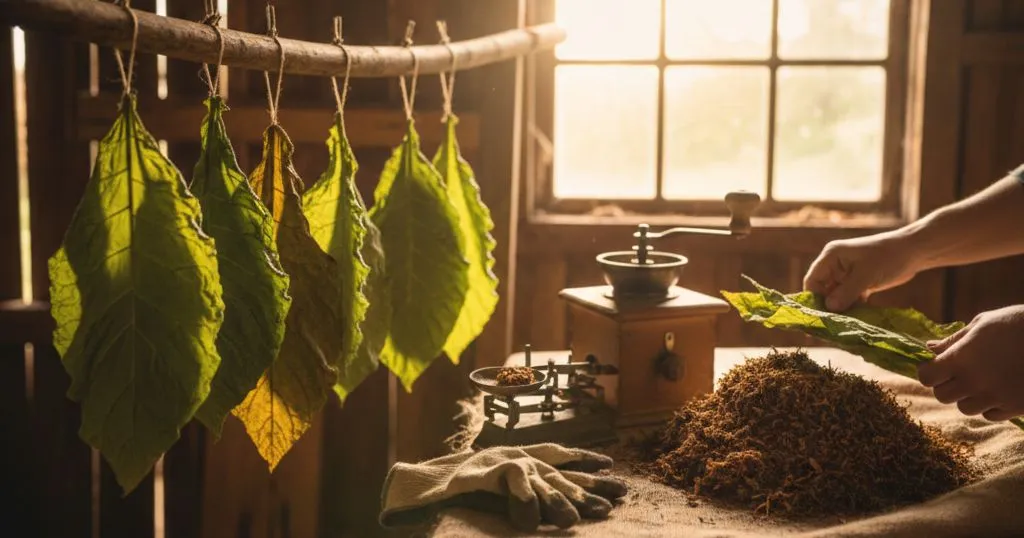
Post-harvest handling — the stringing, hanging, and transport of harvested leaves to curing facilities — must minimize physical leaf damage. Torn, bruised, or crushed leaves create irregular cut edges during primary processing, increase dust generation, and can cause feed flow inconsistencies at the cigarette maker’s tobacco feeder system.
Stage 3 — Curing Nicotiana Leaves
Curing is the post-harvest drying and chemical transformation stage that determines the leaf’s final chemistry for cigarette production. The curing method applied to Nicotiana tabacum is determined by the leaf type — Virginia types are flue-cured, Burley types are air-cured, Oriental types are sun-cured. Each method produces fundamentally different leaf chemistry that determines which blend position the leaf will occupy in the finished cigarette. For a complete guide to each curing method and its implications for factory processing, see our guide to the Tobacco Curing Process: How It Shapes Aroma, Taste and Leaf Quality.
Stage 4 — Fermentation
After curing, commercial tobacco leaf undergoes fermentation — a controlled chemical process that continues the development of flavor compounds, reduces harshness, and stabilizes the leaf chemistry. Fermented leaf is less harsh in use and has more developed aromatic complexity than unfermented cured leaf.
Commercial fermentation is carried out in large controlled piles — called bulks — where the natural microbial activity and enzyme reactions in the tobacco generate heat. The bulk temperature is monitored continuously and the pile is turned when temperature reaches the target maximum — typically 45 to 55 degrees Celsius depending on leaf type — to ensure even fermentation without overheating. Overheating damages the leaf’s aromatic compounds and reduces the quality of the finished tobacco. Fermentation duration varies from several weeks for Virginia leaf to several months for Oriental and specialty types.
Stage 5 — Aging and Storage
Aged leaf tobacco has more complex flavor development and smoother character than freshly fermented leaf. Commercial tobacco leaf is typically aged in controlled storage — cool temperature, stable humidity around 60 to 65 percent relative humidity — for 1 to 3 years before it enters primary processing at the cigarette factory. Longer aging periods are used for premium blend components — particularly Oriental and specialty tobacco types where aromatic complexity increases significantly with extended aging.
Storage conditions at this stage directly affect the leaf moisture specification that arrives at the factory. Leaf stored in unstable humidity conditions may arrive with variable moisture levels that require extended conditioning in the factory’s primary processing section before it can be cut to specification — adding processing time and energy cost.
From Nicotiana Leaf to Factory Primary Processing
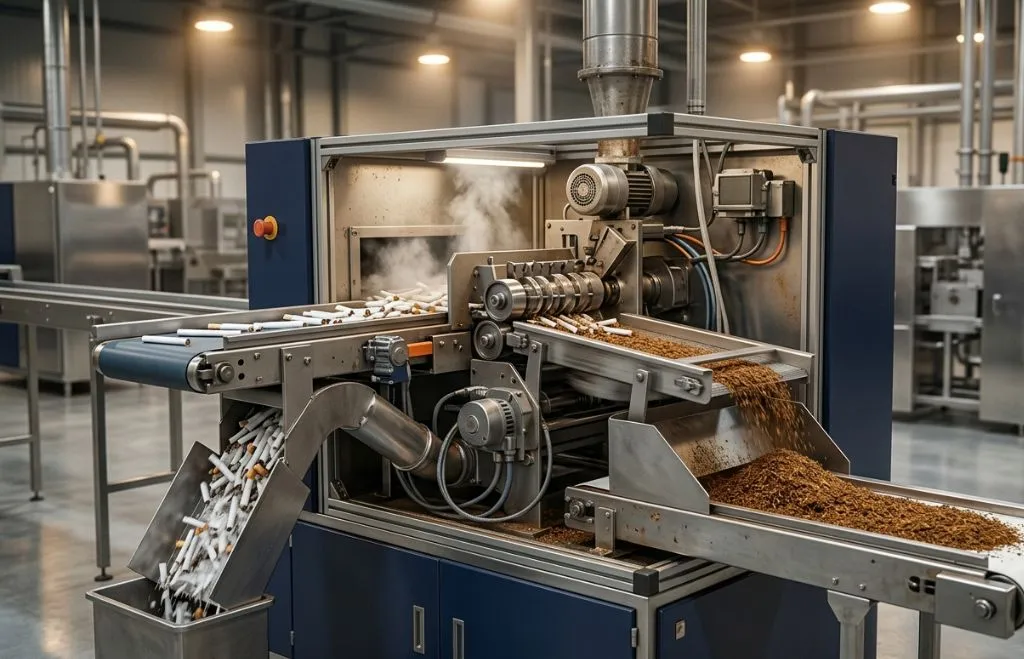
When aged and conditioned Nicotiana tabacum leaf arrives at the cigarette factory it enters the primary processing section — where it is conditioned to the correct moisture, stripped, blended with other leaf types and reconstituted tobacco components, cut to the specified cut width, and delivered to the cigarette making machine via the tobacco feeder system. The quality of the Nicotiana leaf at this point — its moisture content, chemical composition, physical integrity, and consistency — determines how smoothly primary processing runs and how consistently the cigarette making machine produces on-specification cigarettes. For a complete guide to how the production process flows from leaf arrival to finished cigarette, see our guide to How the Tobacco Production Process Works Step by Step.
Frequently Asked Questions
What is Nicotiana plant tobacco production?
Nicotiana plant tobacco production is the agricultural and post-harvest process that transforms Nicotiana tabacum leaf from its raw harvested state into cured, fermented, and aged leaf tobacco suitable for commercial factory processing. It covers cultivation, harvesting, curing, fermentation, and aging — each stage determining aspects of the leaf chemistry and physical quality that affect downstream primary processing and cigarette making machine performance.
Which Nicotiana species is used for commercial cigarette production?
Commercial cigarette production uses Nicotiana tabacum exclusively — specifically its Virginia, Burley, and Oriental botanical types. Virginia type is flue-cured producing high-sugar, bright leaf. Burley type is air-cured producing low-sugar, high-nicotine leaf. Oriental type is sun-cured producing aromatic, small-leaf tobacco. Each type occupies a different position in commercial cigarette blends based on its chemical characteristics.
How does Nicotiana leaf fermentation affect cigarette production quality?
Fermentation continues the development of flavor compounds in the leaf and reduces harshness. Properly fermented leaf produces a cigarette with more developed aromatic complexity and smoother character than unfermented leaf. From a factory processing perspective, fermented leaf also has more stable chemical composition — it behaves more consistently in primary processing and produces more predictable blend quality than unfermented leaf of the same variety.
How long is Nicotiana tobacco leaf aged before factory processing?
Commercial tobacco leaf is typically aged for 1 to 3 years after fermentation before entering factory primary processing. Virginia leaf is typically aged for 1 to 2 years. Oriental and specialty types may be aged for 2 to 3 years or longer. Aging continues the development of aromatic complexity and mellows the leaf character. Longer aging periods are used for premium blend components where flavor development justifies the extended storage cost.
Conclusion
Nicotiana plant tobacco production is the upstream foundation of every cigarette manufactured commercially. The cultivation decisions — variety selection, topping timing, irrigation management — the curing method applied, the fermentation conditions, and the aging duration all determine the chemical and physical quality of the leaf that arrives at the cigarette factory as raw material. Factory buyers who understand these upstream stages can better interpret incoming leaf quality data, communicate specifications to leaf suppliers, and identify when production inconsistencies trace back to leaf quality rather than machine performance. For a complete guide to how incoming leaf flows through primary processing and into the cigarette making machine, see our guide to What Is Tobacco Filler and How It Shapes Cigarettes. For tobacco machinery suppliers in USA who supply primary processing equipment, see our dedicated suppliers page.