Investing in cigarette making machinery is one of the most significant capital decisions a tobacco manufacturer can make. The right machine determines your factory’s output capacity, product consistency, operational costs, and long-term competitiveness. The wrong decision whether it is the wrong speed tier, the wrong brand, or a refurbished unit without proper inspection can cost millions of dollars in lost production and downtime.
This guide is written specifically for factory owners, production managers, and procurement teams evaluating cigarette manufacturing equipment. It covers everything from machine types and speeds to brand comparisons, pricing, and how to source reliable tobacco machinery suppliers in the USA.
What Is Cigarette Making Machine?
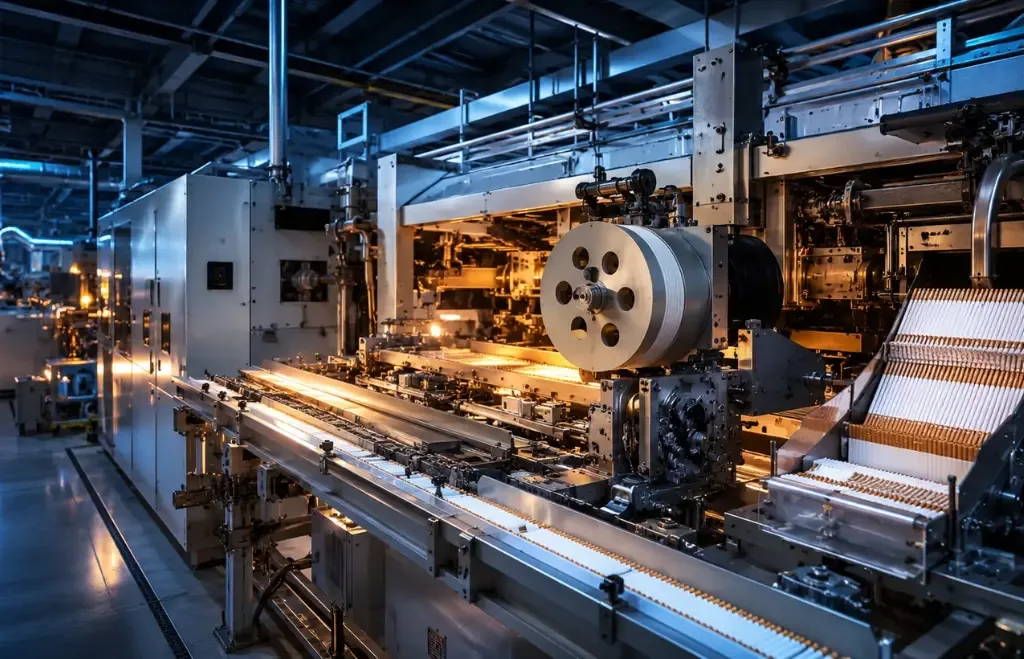
An cigarette making machine also called a cigarette maker or cigarette rod-making machine, is a high-speed automated system that continuously forms, wraps, and cuts cigarettes from loose tobacco and rolling paper. Modern technology has transformed how cigarette production works, with today’s machines incorporating AI quality control, IoT connectivity, and precision automation that was unthinkable two decades ago.
The core process inside every cigarette maker follows the same sequence. Understanding this process helps factory buyers evaluate machines intelligently and ask the right questions of any supplier. For a full overview of how the tobacco production process works, including upstream and downstream stages, see our dedicated guide.
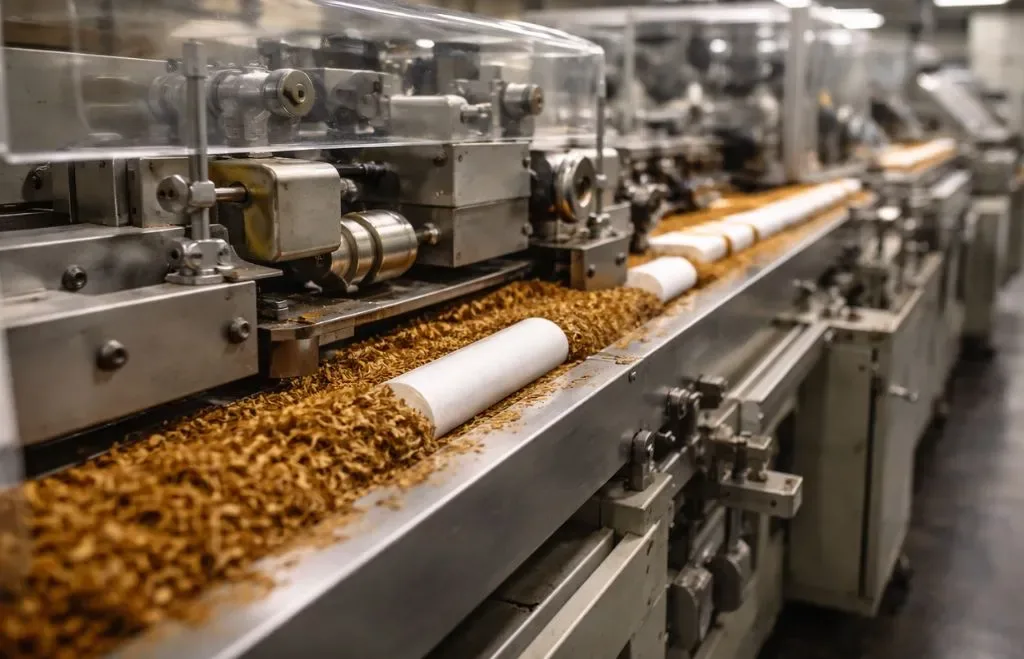
- Tobacco feeding: Loose cut tobacco is fed from a hopper into the machine’s garniture section. The tobacco feeder system controls the flow rate and ensures consistent density throughout the rod.
- Rod formation: The tobacco is compressed into a continuous rod shape and wrapped in cigarette paper. An adhesive glue line seals the paper seam as the rod moves forward at speed.
- Inspection: Rod density and diameter are continuously monitored by integrated quality control sensors. Rods failing specification are automatically rejected before cutting.
- Cutting: A precision cutting head severs the continuous rod into individual cigarettes at the required length. Modern machines achieve this at speeds of up to 20,000 cuts per minute.
- Filter attachment: The cigarette rod exits the maker and immediately enters a cigarette filter assembler, which joins a filter to one end of each cigarette.
- Transfer to packing: Finished cigarettes are conveyed via tray systems or directly into the packing machine that follows in the production line.
Key metric: CPM (Cigarettes Per Minute)
All cigarette machines are rated by their CPM output. This single figure determines which machine tier a buyer needs and has a direct impact on capital cost, factory footprint, staffing, and ROI timeline. Always confirm the rated CPM alongside the realistic operating CPM, which accounts for changeovers, maintenance windows, and quality rejection rates.
Production Speed Tiers: Low, Mid, and High-Speed Machines
The cigarette machinery market is segmented into three speed tiers. Choosing the right tier is one of the most critical procurement decisions a factory buyer will make. The top trends in cigarette machinery technology for 2026 show a clear shift toward higher automation and digital integration across all speed tiers.
| Speed Tier | CPM Range | Daily Output* | Typical Buyer | Key Brands | Approx. CAPEX |
| Low-speed | Up to 3,000 cpm | Up to 4.3M/day | New entrants, pilot lines, R&D | SASIB, Molins mid-range models | $80K–$300K |
| Mid-speed | 3,000–5,500 cpm | 4.3M–7.9M/day | SME manufacturers, regional factories | Molins Alto/Octave, SASIB, ITM | $300K–$800K |
| High-speed | 5,500–20,000+ cpm | 7.9M–28M+/day | Large national/global manufacturers | Körber Protos, G.D double-rod | $800K–$3M+ |
*Daily output figures assume 24-hour operation at 85% efficiency. Actual output will vary based on tobacco type, format, maintenance schedule, and operator experience.
Low-Speed Machines (Under 3,000 CPM)
Low-speed machines are suited to small factory operations, test batch production, or manufacturers entering the market for the first time. They require less floor space, fewer trained operators, and lower capital investment. SASIB and the lower end of the Molins range serve this segment. For R&D departments, Körber’s Lab Maker produces up to 2,000 cpm specifically for new product development and test market batches.
Mid-Speed Machines (3,000–5,500 CPM)
Mid-speed machines represent the workhorses of the global tobacco industry, particularly for manufacturers in developing markets and regional producers. The Molins Mark 8 and Mark 9 series have historically dominated this segment, with a large global installed base still in active production. Mid-speed machines offer a sensible balance between output and capital cost, and many are available in the refurbished market at significantly reduced prices.
High-Speed Machines (5,500–20,000+ CPM)
High-speed machines are the production backbone of major global tobacco companies. The Protos 80 ER and the newer Protos M5 dominate this tier, with the M5 reaching 20,000 cpm incorporating AI-powered quality control. G.D’s double-rod makers achieve 10,000–16,000 cpm from a single machine unit. These machines require substantial factory infrastructure and trained engineering staff.
Single-Rod vs Double-Rod Cigarette Makers
One of the most important technical distinctions in cigarette making machinery is the difference between single-rod and double-rod production systems. This choice directly impacts output capacity, factory footprint, and equipment cost.
| Feature | Single-Rod Maker | Double-Rod Maker |
| Production rods | One continuous rod formed at a time | Two parallel rods formed simultaneously |
| Typical speed range | Up to 10,000 cpm | 10,000–20,000 cpm from one machine |
| Factory footprint | Smaller — suitable for constrained floor plans | Larger — requires more floor space and infrastructure |
| Capital cost | Lower upfront investment | Higher upfront, lower cost-per-cigarette at scale |
| Complexity | Lower mechanical complexity | More complex, requires more skilled operators |
| Typical applications | SME to mid-scale manufacturers | Large-scale, high-volume global manufacturers |
| Key suppliers | Molins, SASIB, lower Körber range | G.D (Coesia), Körber Protos high-end |
For most manufacturers entering the market or operating at regional scale, single-rod machines are the appropriate starting point. Double-rod systems are justified when a factory’s capacity requirements exceed what a single-rod machine can deliver efficiently, or when the economics of a single high-speed double-rod unit are more favorable than running two single-rod machines in parallel.
Major Cigarette Machinery Brands
The global cigarette machinery market is concentrated among a small number of established manufacturers. Understanding each brand’s strengths, speed range, and market positioning is essential before making a sourcing decision. The innovations that changed the tobacco industry have largely been driven by these same manufacturers pushing the boundaries of automation, quality control, and digitalization.
Körber Technologies (Hauni)
Körber Technologies is the dominant force in high-speed cigarette manufacturing machinery, holding an estimated 80% share of the high-speed maker market globally with over 3,000 active patents. Its flagship Protos series sets the global benchmark. The Protos 70 and Protos 80 ER represent the proven mid-to-high speed range, while the PROTOS-M5 pushes to 20,000 cpm with integrated AI quality control. Körber maintains strong support infrastructure for North American customers.
Molins
Established in 1912, Molins focuses on the mid-speed segment and has an extensive installed base across Europe, the Americas, and Asia-Pacific. The Mark 8 with Multi Roll, the Mark 8, and the Mark 9 with Max S remain among the most widely deployed cigarette makers in the world. This makes Molins the most represented brand in the refurbished cigarette machinery market.
G.D S.p.A. (Coesia Group)
G.D S.p.A. is the only manufacturer offering complete high-speed production lines, cigarette making, filter production, packing, and secondary packaging from a single group. G.D’s cigarette makers are double-rod systems producing 10,000–16,000 cpm, competing directly with Körber at the top of the market. The company has been particularly active in developing machinery for Heat-Not-Burn product lines.
SASIB S.p.A. (Coesia Group)
SASIB operates in the low and mid-speed segment, complementing G.D’s high-speed focus within the Coesia Group. The SASIB 3000 and the SASIB Boxer are well-proven machines particularly well-positioned for smaller factory operations in the USA. Their after-sales service and spare parts supply are managed through the Coesia Group’s global network.
Other Notable Manufacturers
Orchid Tobacco: A UAE-based supplier offering both new and refurbished cigarette machinery, with a strong focus on serving emerging market manufacturers. Supplies Protos, Molins, and other brand equipment with in-house rebuild capability.
ITM Group : Specializes in customer-centric, tailored tobacco machinery solutions. Known for strong after-sales support and consultative sales approach.
Focke & Co.: A major supplier of cigarette packaging machinery. The HLP 250 is one of their flagship packing systems, handling up to 250 packs per minute.
Brand selection guidance for USA buyers:
For large-scale production (5,500+ cpm): Körber Protos or G.D double-rod systems are the industry standard.
For mid-scale production (3,000–5,500 cpm): Molins Mark 8 / Mark 9 series or ITM Group solutions offer proven reliability.
For entry-level / small factory setup: SASIB 3000 range or refurbished Molins machines offer the best risk-adjusted entry point.
For HNB product lines: G.D has the most advanced current offering in cigarette-format HNB machinery.
How the Cigarette Maker Fits Into the Full Production Line
An cigarette making machine does not operate in isolation. It is one node in a connected production line that spans from primary tobacco processing through to finished, packaged product ready for distribution. Understanding how the maker integrates with upstream and downstream equipment is critical for production line planning. The way tobacco wrapping influences burn quality is just one example of how every stage of the line affects the final product.
| Production Stage | Equipment | Connects To | Key Consideration |
| Primary processing | Tobacco cutters, conditioners, blenders | Tobacco feed into maker | Tobacco cut width and moisture must match maker specifications |
| Cigarette making | Rod-forming machine (the maker) | Filter attachment machine | CPM output must match downstream machine capacity |
| Filter attachment | Filter tipping machine (e.g. Max S, Max 5) | Quality inspection / packing | Filter type and length must be configured to maker output format |
| Quality control | Integrated sensors, vision systems | Rejection systems | Continuous monitoring of rod density, diameter, and cut quality |
| Packing | Soft-pack or hard-box packer | Overwrapping machine | Packer speed must synchronise with maker CPM to avoid line stoppage |
| Overwrapping | Cellophane or film wrapper | Cartoning machine | Pack format and size must match overwrapper configuration |
| Cartoning / case packing | Cartoner, case packer | Logistics / dispatch | Output rate must match warehouse and logistics flow |
| Track & trace / coding | Inkjet coders, laser coders | Regulatory compliance | USA manufacturers must comply with FDA traceability requirements |
When planning a production line, the cigarette maker’s rated CPM determines the capacity of every machine downstream. Over-specifying the maker and under-specifying the packer creates costly bottlenecks. For example, cigarette overwrapping is a stage many first-time factory buyers underestimate, the overwrapping machine must be matched in speed to the packing line it connects to. Similarly, tobacco packing choices (soft pack vs hard box) affect which packing machines are needed and how the full line is configured.
New vs Refurbished Cigarette Making Machines
One of the most consequential decisions for any factory buyer is whether to purchase new or refurbished equipment. Both routes have legitimate use cases, and the right choice depends on your budget, timeline, production requirements, and risk tolerance.
The Case for New Machinery
New cigarette making machines offer maximum reliability, full manufacturer warranties, and the latest technology. The latest trends in cigarette machinery technology for 2026, including AI quality control, predictive maintenance, and PLC-based control systems, are only available as standard on new equipment. The PLC control systems used in modern tobacco machinery allow operators to monitor and adjust production parameters in real time, dramatically reducing defect rates and unplanned downtime.
The Case for Refurbished Machinery
The refurbished cigarette machinery market is substantial, well-established, and actively used by legitimate manufacturers worldwide. A properly refurbished machine undergoes full mechanical inspection, worn parts replacement, and electrical system testing. Refurbished machines can offer 50–70% cost savings versus new equivalents at the same speed tier. The Molins Mark 8 and Mark 9 with Max S series in particular have a very active refurbished market, with many units available through specialist dealers.
What to Verify Before Buying Refurbished
- Machine history: How many operating hours? What factory was it used in? Were maintenance logs kept?
- Rebuild scope: Was this a full mechanical rebuild with OEM replacement parts, or a cosmetic refurbishment only?
- Spare parts availability: For older Molins and SASIB models, confirm that key wearing parts are still manufactured or available in aftermarket supply.
- Control system compatibility: Older machines may use obsolete PLC control systems or Lenze servo drives that have limited support. Confirm compatibility and parts availability before purchase.
- Warranty terms: A credible supplier should offer at minimum a 90-day parts and labour warranty on their rebuild work.
- Factory acceptance test: Always request a FAT before shipping, especially for equipment being imported into the USA.
Cigarette Machine Pricing: What to Budget in 2026
Pricing for cigarette manufacturing machinery varies enormously depending on speed tier, brand, age, and configuration. The figures below are market-typical ranges for 2026. Actual quotes will depend on specific machine models, condition, and supplier terms.
| Machine Category | Speed Tier | New Price Range | Refurbished Range | Notes |
| Entry-level single-rod maker | < 3,000 cpm | $80K–$300K | $30K–$120K | SASIB low-speed range, older Molins models |
| Mid-speed single-rod maker | 3,000–5,500 cpm | $300K–$800K | $100K–$350K | Molins Mark 8/9 series, SASIB mid-range |
| High-speed single-rod maker | 5,500–10,000 cpm | $800K–$1.5M | $300K–$700K | Lower Körber Protos range, Protos 70 |
| High-speed double-rod maker | 10,000–20,000 cpm | $1.5M–$3M+ | $600K–$1.5M | Körber Protos M5, G.D double-rod systems |
| Complete making + packing line | Varies | $3M–$10M+ | $1M–$4M+ | Full line: maker, filter, packer, wrapper |
| Filter attachment machine | N/A | $200K–$600K | $60K–$200K | Hauni Max series, G.D filter tippers |
Total cost of ownership: beyond the machine purchase price
Installation and commissioning: typically 5–15% of machine cost, depending on complexity and location.
Operator training: plan for 2–4 weeks of manufacturer-provided training for new equipment.
Spare parts inventory: budget 10–20% of machine cost for an initial critical spare parts stock.
Annual maintenance: expect 5–10% of machine value per year in planned maintenance costs.
Import duties (USA): tobacco machinery is typically 0–3.5% under relevant HTS codes.
Factory infrastructure: electrical supply upgrades, compressed air systems, and HVAC may add significant additional cost.
How to Source Cigarette Machinery Suppliers in the USA
Sourcing industrial tobacco machinery requires a different approach from general capital equipment procurement. The market is specialised and the supplier base is small. Our guide to the best tobacco machinery suppliers in the USA covers the key players and how to evaluate them.
Types of Suppliers
OEM authorised dealers: Direct representatives of manufacturers like Körber and G.D. Best for large, straightforward new equipment purchases with full support requirements.
Independent specialist dealers: Companies that source, refurbish, and sell tobacco machinery across multiple brands. These offer a wider selection of refurbished equipment and are often more flexible on pricing and terms.
Auction and liquidation sources: Factory closures and production line upgrades generate equipment sold through industrial auctions. Prices can be competitive but equipment is sold as-is with no warranty. Full independent inspection is essential.
Turnkey line providers: Suppliers who can source all equipment for a complete production line, manage installation, and commission the full system. For first-time manufacturers, a turnkey approach significantly reduces integration and commissioning risk.
Key Questions to Ask Any Supplier
- What is the machine’s documented production history, operating hours, maintenance records, and previous factory of use?
- What does the warranty cover, and for how long? Is it on the rebuild work only, or on the machine as a whole?
- Does the supplier have experience with USA import compliance and can they support the customs documentation process?
- Is spare parts supply guaranteed for this machine model, and from where are parts shipped?
- Will the supplier provide on-site installation and commissioning support, and is this included in the quoted price?
- Can the supplier provide references from other USA or North American customers who have purchased similar equipment?
USA Regulatory Considerations for Cigarette Manufacturers
Operating a cigarette manufacturing facility in the United States requires compliance with federal regulations from two separate agencies. Understanding the regulatory landscape is essential before committing to machinery purchases. The tobacco trends driving exports also reflect how regulatory developments are shaping global demand for different machine configurations.
Alcohol and Tobacco Tax and Trade Bureau (TTB)
Any entity manufacturing cigarettes for commercial sale in the USA must obtain a Federal Basic Permit from the TTB before commencing production. Lead time for permit approval can range from several months to over a year, meaning applications should be initiated early in the factory planning process — well before machinery is installed.
Food and Drug Administration (FDA) Center for Tobacco Products
The FDA regulates tobacco products under the Family Smoking Prevention and Tobacco Control Act. Any USA cigarette manufacturer must register with the FDA and comply with product standards. In 2026, the FDA’s proposed Tobacco Product Manufacturing Practice (TPMP) rule is advancing toward finalization, introducing GMP-like requirements covering manufacturing process controls, quality systems, and product storage. Machines with integrated PLC control systems and digital process documentation will be better positioned for TPMP compliance than older machines without electronic record-keeping capability.
Automation and Control Systems
Modern cigarette makers integrate sophisticated control systems. Siemens IPC and Beckhoff IPC are commonly used industrial PCs in tobacco factory automation. Similarly, Lenze servo drives are widely deployed in mid-speed cigarette makers for precision control of the rod formation and cutting processes. Understanding which control systems a machine uses is important for both maintenance planning and TPMP compliance readiness.
10. Frequently Asked Questions
What is the minimum production speed for a commercially viable cigarette factory?
Most industry consultants consider a sustainable commercial operation to require at least 1,000–2,000 cpm of reliable output. However, the economics typically improve significantly at 3,000+ cpm. Startups should assess their target market volume carefully before selecting a machine speed tier. The automatic cigarette maker segment is particularly relevant for manufacturers starting at the lower end of commercial production.
How long does a cigarette making machine last?
With proper maintenance, a quality cigarette maker has an operational lifespan of 20–30 years or more. Körber and Molins machines from the 1990s remain in active production globally. Regular preventive maintenance, timely replacement of wearing parts, and operator training are the three most important factors in maximizing machine lifespan.
What tobacco cut width do cigarette machines require?
Most cigarette makers are optimized for tobacco cut widths of 0.8–1.2 mm. The tobacco leaf shredder and cutting equipment used in primary processing must be configured to match the downstream maker’s tobacco specification. Tobacco that is too coarsely cut produces inconsistent rod density; too fine a cut can cause garniture blockages.
Can cigarette makers produce slim or super-slim cigarettes?
Yes, most modern cigarette makers can be configured for different cigarette diameters, standard (approximately 7.9 mm), slim (approximately 5.3 mm), super-slim (approximately 4.5 mm), and other formats. A machine must be fitted with different format parts to switch between diameters. What makes thin cigarettes different from a production standpoint is primarily the format parts and garniture settings, not the fundamental machine architecture.
What are the main differences between Körber and Molins machines for a mid-size factory?
For a mid-size factory targeting 3,000–6,000 cpm, Körber machines deliver superior digitalization and manufacturer support but at a higher price. Molins mid-speed machines, including the Mark 8 and Mark 9 with Max S, are well-proven and supported by an active refurbished parts market, making them strong value for buyers who want reliability without the Körber premium.
How long does it take to install and commission an cigarette production line?
For a single new machine with existing factory infrastructure, commissioning typically takes 4–8 weeks. A complete new production line, including maker, filter assembler, packing, and secondary packaging, typically requires 3–6 months from equipment arrival to full production output.
What is the difference between a cigarette maker and a cigarette packing machine?
A cigarette maker forms the tobacco rod, wraps it in cigarette paper, and cuts it into individual cigarettes. A cigarette packing machine takes finished cigarettes and packages them into retail packs. These are separate machines that operate in sequence. Soft pack cigarettes and hard box formats require different packing machines and are configured differently in the production line.
How does the Hauni KDF filter machine integrate with the cigarette maker?
The Hauni KDF filter machine produces filter rods that are then consumed by the filter attachment machine (tipper) which joins them to the cigarette rod exiting the maker. The KDF operates upstream of the maker-tipper system, producing filter rods at a rate matched to the maker’s output speed. Proper speed synchronisation between the KDF, the maker, and the tipper is essential for minimising downtime and waste.
Making the Right Machinery Decision in 2026
The cigarette manufacturing machinery market in 2026 offers more options than ever, from AI-integrated high-speed systems producing 20,000 cigarettes per minute to well-proven refurbished mid-speed machines that have operated reliably for decades. The right choice is never simply the most powerful or the cheapest option. It is the machine that matches your factory’s production targets, infrastructure, capital budget, staffing capability, and long-term growth plan.
For manufacturers evaluating options in the USA market, the following principles apply regardless of which machine tier or brand is under consideration:
- Define your target CPM before approaching any supplier — this single figure narrows the field and protects you from being over-sold on capacity you do not need.
- Get your TTB and FDA registrations in process early — regulatory approvals take longer than equipment lead times in most cases.
- Evaluate the total cost of ownership, not just the purchase price — installation, training, spare parts, and maintenance costs are material and must be modelled.
- Inspect refurbished equipment thoroughly before purchase and always request a factory acceptance test before shipment.
- Understand the control systems on any machine you are evaluating, whether Siemens IPC, Beckhoff, or Lenze servo drives, as these determine maintenance complexity and TPMP compliance readiness.