
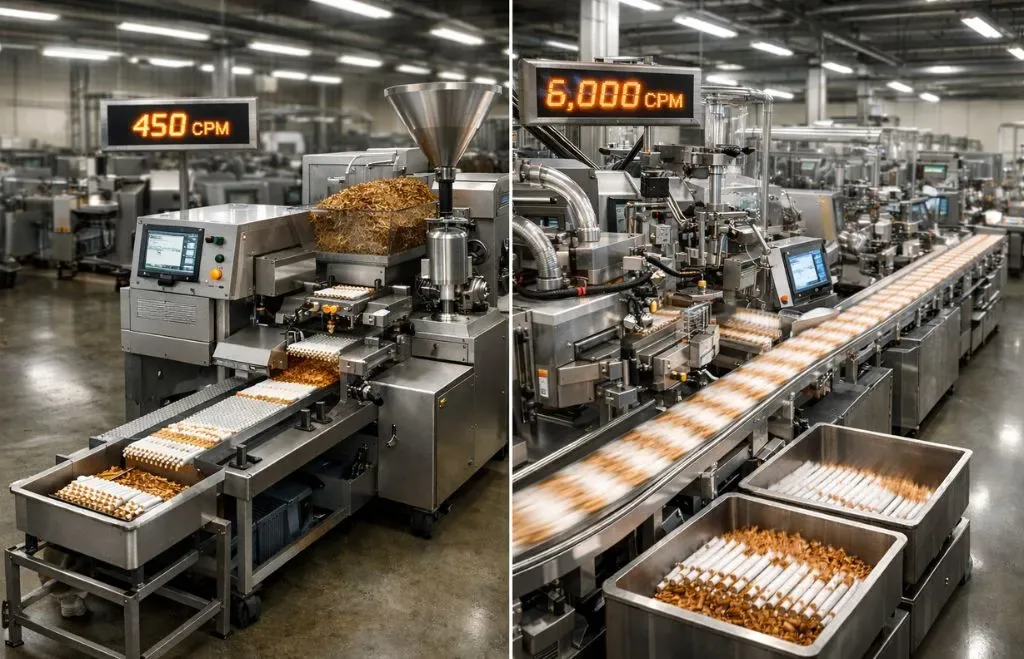
High Speed vs Mid Speed Cigarette Machine: Which Is Right for Your Factory?
The high speed vs mid speed cigarette machine decision is one of the most consequential, and most frequently misjudged, capital equipment choices a tobacco manufacturer will make. Buy too slow and you hit a capacity ceiling just as demand grows. Buy too fast and you carry expensive underutilized equipment, a more complex maintenance burden, and factory infrastructure costs you did not need yet.
This guide cuts through the noise and gives factory owners, production managers, and procurement teams a clear, structured comparison of high-speed and mid-speed cigarette manufacturing machines across every factor that matters: output capacity, capital cost, total cost of ownership, factory infrastructure requirements, staffing, maintenance complexity, refurbished machine availability, and scalability. For an overview of all three speed tiers including low-speed entry machines, see our guide to industrial cigarette making machine types, speeds, and capacity.
1. High Speed vs Mid Speed Cigarette Machine: Defining the Two Tiers
A high speed cigarette manufacturing machine typically starts at 5,500 cpm and can reach 20,000+ cpm on double-rod platforms. A mid speed cigarette manufacturing machine operates between 3,000 and 5,500 cpm — the most widely deployed speed tier in the global tobacco industry.
Before comparing them, it is worth being precise about what ‘high-speed’ and ‘mid-speed’ actually mean in technical terms. These are industry-standard categories based on CPM (cigarettes per minute).
| Parameter | Mid-Speed Machines | High-Speed Machines |
|---|---|---|
| CPM range | 3,000–5,500 cpm | 5,500–20,000+ cpm |
| Annual output (3 shifts, 85% efficiency) | ~2.2 billion – 4.0 billion cigarettes | ~4.0 billion – 14.6 billion+ cigarettes |
| Rod architecture | Single-rod (standard) | Single-rod or double-rod |
| Representative machines (new) | Mark 9 with Max S, Mark 8 with Multi Roll, SASIB 3000 | Protos 70, Protos 80 ER, G.D double-rod |
| New machine entry price | $300K – $800K | $800K – $3M+ |
| Refurbished availability | High — large global installed base | Limited at top end; moderate for Protos 70 range |
| Typical buyers | Regional manufacturers, SMEs, market entrants | Large national/multinational manufacturers |
2. Cigarette Machine CPM Comparison: Output Capacity by Speed Tier
Output capacity is the starting point. Before any other comparison is relevant, you need to know whether each tier can actually meet your production requirements, now and over the next five to ten years.
| Scenario | Mid-Speed Machine (4,500 cpm) | High-Speed Machine (8,000 cpm) |
|---|---|---|
| Realistic operating CPM (85% efficiency) | 3,825 cpm | 6,800 cpm |
| Output per 8-hour shift | 1.84 billion cigarettes | 3.26 billion cigarettes |
| Output per day (3 shifts) | 5.51 billion cigarettes | 9.79 billion cigarettes |
| Output per year (330 operating days) | 1.82 trillion cigarettes | 3.23 trillion cigarettes |
| Packs per day (20 cigarettes) | 275.5 million packs | 489.8 million packs |
| Output gap vs high-speed | — | 77% more output per machine |
The output gap between these two tiers is substantial, a high-speed machine at 8,000 cpm produces roughly 77% more cigarettes per day than a mid-speed machine at 4,500 cpm under the same operating conditions. But raw output is only part of the story. The question is not which machine produces more, it is which machine produces the right amount for your market at the right cost per cigarette. A high-speed machine running at 40% utilisation because demand does not justify full output is not an advantage it is a cost burden.
3. Cigarette Manufacturing Machine Cost Comparison: Capital Cost and TCO
Purchase price is the most visible cost in any machinery decision, but it is rarely the most important one over a 10-to-15-year asset life. Total cost of ownership (TCO) is what actually determines whether an equipment choice was the right one.
| Cost Category | Mid-Speed Machine | High-Speed Machine | Notes |
|---|---|---|---|
| Machine purchase (new) | $300K–$800K | $800K–$3M+ | High-speed premium: 2.5–4x mid-speed at same brand |
| Machine purchase (refurbished) | Molins Mark 8 / Mark 9: $100K–$350K | Protos 70: $300K–$700K | Strong refurbished market for mid-speed tier |
| Factory infrastructure upgrade | $50K–$200K | $150K–$500K+ | Electrical, compressed air, HVAC; higher for high-speed |
| Installation & commissioning | $30K–$100K | $80K–$250K | Typically 8–12% of machine cost |
| Annual maintenance (% of machine value) | 5–8% | 7–10% | Higher complexity = higher ongoing cost |
| Spare parts inventory (initial) | $30K–$80K | $80K–$200K | More critical components at higher speeds |
| Operator training | 2–3 weeks | 3–5 weeks | High-speed requires more intensive training |
| Cost per 1,000 cigarettes at full utilisation | Higher | Lower | High-speed advantage grows with volume |
| Typical TCO payback period | 3–6 years | 5–9 years | Depends heavily on utilisation rate |
The cost-per-cigarette advantage of high-speed machines is real, but it only materializes at sustained high utilization. A manufacturer running a high-speed line at 60% capacity pays the full TCO without capturing the full cost-per-unit benefit. This is the most common error in speed tier selection: buying based on aspirational output targets rather than realistic near-term production requirements.
4. Factory Infrastructure Requirements
The machine is not the only investment. Every cigarette making machine requires supporting factory infrastructure, and the requirements scale sharply with speed. Many factory buyers underestimate this cost when comparing tiers.
| Infrastructure Factor | Mid-Speed Requirements | High-Speed Requirements |
|---|---|---|
| Floor space | Smaller footprint; typically 60–100 m² for maker + filter + packer | Larger footprint; 100–200+ m² including buffer systems and conveyors |
| Floor loading | Standard industrial floor loading adequate | Higher floor loading specification required; structural assessment recommended |
| Electrical supply | 3-phase industrial power; 50–100 kVA typical | 3-phase industrial power; 100–300+ kVA depending on full line configuration |
| Compressed air | Standard compressed air supply; 6–8 bar | Higher volume compressed air; dedicated compressor often required |
| HVAC & dust control | Standard industrial HVAC; tobacco dust extraction | Enhanced HVAC with higher-capacity dust extraction; critical at high speeds |
| Vibration isolation | Standard industrial flooring adequate | Anti-vibration mounting recommended for precision cutting at high speeds |
| Standard industrial network infrastructure | High-speed machines typically use more complex automation networks; IT infrastructure investment required | |
| Standard IPC platforms; widely available technical support | More advanced IPC configurations; specialist IT support may be needed | |
| Waste recovery system | Cigarette reclaimer standard; moderate capacity | High-capacity waste recovery essential; cost-recovery from tobacco waste is material at high volumes |
A useful planning principle: budget an additional 20–30% of the machine purchase price for factory infrastructure when moving from mid-speed to high-speed for the first time. This estimate covers the most common surprise costs, electrical supply upgrades, enhanced dust extraction, and pneumatic cylinder and compressed air system capacity. Experienced machinery suppliers, including those on our list of tobacco machinery suppliers in the USA, should provide a factory readiness checklist as part of any serious equipment proposal.
5. Staffing and Operator Skill Requirements
The human factor in speed tier selection is frequently underweighted. Industrial cigarette making machines at both tiers require trained operators, but high-speed machines demand a meaningfully higher level of technical expertise that has direct implications for recruitment, training costs, and operational risk.
| Staffing Factor | Mid-Speed (per machine) | High-Speed (per machine) |
|---|---|---|
| Operators per shift | 1–2 operators | 2–3 operators (higher speeds require closer monitoring) |
| Skill level required | Experienced cigarette machine operator; standard certification | Advanced cigarette machine technician; higher-level fault diagnosis and process control skills |
| Training duration (new equipment) | 2–3 weeks manufacturer training | 3–5 weeks; more complex machine architecture requires longer training |
| Fault diagnosis complexity | Moderate; fewer concurrent systems | Higher; more sensors, faster response needed, complex interactions between systems |
| Availability of trained operators | Wider pool; mid-speed machines most common globally | Smaller pool; Körber Protos operators are a specialist skill in the labour market |
| Risk of single-operator dependency | Lower — skill is more transferable | Higher — complex machines create dependency on specific technicians |
The staffing constraint is particularly relevant for manufacturers in the USA. Experienced cigarette machine operators, especially those trained on high-speed Körber Protos equipment, are not abundant in the US labour market. A manufacturer commissioning a high-speed line for the first time should budget for longer onboarding periods and factor in the cost of extended manufacturer training. The PLC control systems and Lenze servo drives used in these machines require operators who understand both the mechanical process and the automation systems managing it, a combination of skills that takes time to develop.
6. Maintenance Complexity and Spare Parts
Both speed tiers require rigorous preventive maintenance. However, the complexity and cost of maintaining a high-speed machine, particularly at the cutting mechanism, tobacco feeder, and inspection systems, is materially higher than its mid-speed equivalent.
| Maintenance Factor | Mid-Speed | High-Speed |
|---|---|---|
| Maintenance interval frequency | Standard schedules; well-documented for major brands | Tighter intervals at key components due to higher mechanical stress |
| Spare parts cost per year | Lower; wider supplier base for mid-speed brands | Higher; some high-speed components are brand-specific and expensive |
| OEM spare parts availability (Molins Mark 8/9) | Excellent — large global installed base; strong aftermarket | Good for current Körber/G.D models; older Protos variants may have longer lead times |
| Cutting blade replacement | Moderate frequency; lower cost per blade | Higher frequency at high CPM; precision blades have higher unit cost |
| Garniture tape replacement | Standard schedule; widely available | Tighter specification; must match high-speed rod formation requirements |
| Downtime cost per hour | Significant, but lower absolute output lost | Higher absolute cigarette output lost per hour of downtime |
| Predictive maintenance capability | PLC systems enable basic fault logging; predictive tools available as add-on | AI and IoT predictive maintenance standard on latest Körber PROTOS-M5 |
One critical advantage mid-speed machine hold is spare parts market depth. The Molins Mark 8, Mark 8 with Multi Roll, and Mark 9 with Max S have been in production globally for decades, creating a deep aftermarket for replacement parts, including from specialist suppliers in the USA. A manufacturer running a Molins mid-speed machine is far less exposed to supply chain delays on critical wearing parts than one running a recently introduced high-speed model.
7. Refurbished Machine Availability
The refurbished cigarette manufacturing machine market is a critical consideration for any manufacturer for whom upfront capital cost is a constraint.
| Factor | Mid-Speed Refurbished Market | High-Speed Refurbished Market |
|---|---|---|
| Market depth | Deep — Molins Mark 8/9 series have hundreds of units in global circulation | Moderate — Protos 70 and 80 ER available; Protos M5 and latest G.D models rarely available refurbished |
| Price range | Mark 8 / Mark 9: $100K–$350K rebuilt | Protos 70: $300K–$700K rebuilt; Protos 80 ER: $500K–$1.2M |
| Quality of rebuild available | Specialist rebuilders (e.g. Makepak International) offer full OEM-standard rebuilds | Fewer specialist rebuilders at this level; OEM-backed refurbishment programmes exist but are more expensive |
| Spare parts for refurbished units | Excellent — aftermarket is well-developed | Good for current production models; older variants require lead time planning |
| Risk profile | Lower — well-understood machines with known failure modes | Higher — fewer reference points for buyer; due diligence more critical |
| Suitable for first-time factory? | Yes — with proper supplier vetting and FAT | Caution — complexity makes first-time commissioning of refurbished high-speed machines high-risk |
For most new USA manufacturers and SME operators, a professionally rebuilt Molins Mark 9 with Max S or Mark 8 with Multi Roll represents the most practical entry point for factory-grade production. The combination of proven reliability, strong parts availability, and the depth of the refurbished market makes mid-speed Molins machines the default choice for cost-conscious factory buyers, unless production volume genuinely demands a step up.
8. Downstream Line Implications
The speed tier of the cigarette maker determines the capacity specification of every machine downstream. This is a frequently overlooked but financially significant consequence of the tier decision.
| Downstream Stage | Mid-Speed Line Requirements | High-Speed Line Requirements |
|---|---|---|
| Filter attachment | Filter assembler rated to 4,000–6,000 cpm | Filter assembler rated to 6,000–12,000+ cpm; higher cost |
| Filter rod production | Hauni KDF mid-range models adequate | Higher-capacity KDF models; multiple units may be needed for very high-speed lines |
| Packing machine | HLP 250 (250 packs/min) typically adequate | Higher-specification packers required; multiple parallel packing lines common |
| Box packing | SASIB Boxer standard configuration | Higher-capacity boxing equipment; automated carton handling more critical |
| Overwrapping | Cigarette overwrapping — standard line speed | Naked over-wrapper and film wrapper at higher throughput specification |
| Tobacco feeding | Tobacco feeder standard mid-range capacity | Higher-capacity feeder; continuous automatic refill systems more important |
| Waste recovery | Cigarette reclaimer — standard system | Higher-capacity reclaimer; tobacco waste value is more significant at high volumes |
The practical implication: upgrading from a mid-speed to a high-speed cigarette maker is not simply a machine swap. It requires re-specifying and often replacing downstream equipment across the full production line, a capital investment that can easily equal or exceed the cost of the maker itself. This ‘full line upgrade cost’ must be included in any honest TCO comparison between the two tiers. For context on how each stage connects, see our article on the tobacco production process step by step.
9. The Decision Framework: 8 Questions to Ask Before Choosing
Run through these eight questions before committing to either tier. If the majority of your answers point in one direction, you have your answer.
- What is your realistic 3-year production target? If it is under 4 billion cigarettes per year, a mid-speed machine at full utilisation covers you. If it is above that, high-speed becomes the more efficient option.
- Is your factory infrastructure already high-speed ready? If not, cost the infrastructure upgrade before comparing machine prices. It often shifts the TCO comparison significantly.
- Do you have access to trained high-speed machine operators? If your local labour market does not have Körber Protos experience, budget for extended manufacturer training and factor in the risk of key-person dependency.
- What is your capital budget for the full line, not just the maker? Remember that downstream machines must be matched to the maker’s CPM. A high-speed maker paired with a mid-speed packer creates a bottleneck that eliminates the output advantage.
- Is the refurbished market an option for you? If yes, mid-speed offers significantly more choice, better-vetted equipment, and lower per-unit risk. A rebuilt Mark 9 with Max S at $150K is a very different risk profile from a rebuilt Protos 80 ER at $600K.
- How important is format flexibility to your business? If you produce multiple cigarette formats (king size, slim, thin), changeover time and format parts cost matters. Mid-speed machines typically offer simpler changeover.
- What is your tolerance for operational risk? High-speed lines are less forgiving of maintenance lapses. An unplanned stoppage costs more in absolute cigarette output per hour. If your factory does not yet have robust preventive maintenance systems in place, mid-speed carries lower operational risk.
- What does your 10-year growth plan look like? If you expect to double production within five years, the infrastructure investment in a high-speed line may be justified now. If growth is modest and steady, a mid-speed machine with a clear upgrade path is the more prudent choice.
Summary: The Right Tier Is the One That Matches Your Factory’s Reality
High-speed machines produce more cigarettes per hour. Mid-speed machines cost less to buy, less to run, and less to maintain, and have a far deeper refurbished market. Neither tier is universally superior. The question is always which tier matches your current production requirements, your factory’s physical capabilities, your team’s technical skills, and your capital position.
The most expensive mistake in cigarette machinery procurement is not buying the wrong brand, it is buying the wrong speed tier. An over-specified high-speed machine running at half capacity, or an under-specified mid-speed machine hitting its ceiling six months after commissioning, both represent decisions that cost far more than the machine price difference.
Use the eight questions in Section 9 as your decision checklist. If you are still uncertain, consult our recommended tobacco machinery suppliers in the USA, experienced suppliers will provide a factory readiness assessment and line balance analysis as part of any serious proposal.

Looking for Cigarette Machinery?
Browse our current inventory of manufacturing, filter making, packing, and wrapping equipment, or send us your target speed and format for a fast quote.