
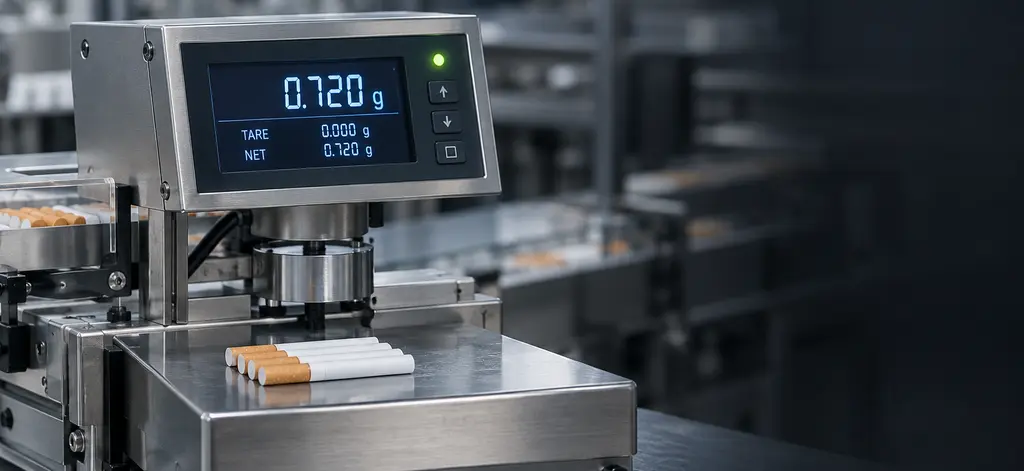
How to Evaluate a Used Cigarette Machine's Weight Control System Before Buying
Weight and circumference control on a cigarette machine is not a feature you can judge from a photo or a spec sheet. It's a mechanical and electronic system that drifts over time, and on a used machine, how well it was maintained by the previous owner determines whether you're buying consistent output or a slow-motion quality problem. This is one of the areas worth checking closely before you commit to a purchase, not after.
The Two Control Types You'll See
Different machine categories use different control methods, so what you check depends on what you're buying.
Microwave weight control is used on cigarette manufacturing machines like the Protos 80 ER and Protos 70. It checks cigarette weight continuously as the machine runs, rather than through periodic manual sampling.
Laser circumference control is used on filter making machines like the Hauni KDF-1 and Hauni KDF-2. It monitors filter diameter against spec in real time.
Both systems exist for the same reason: to catch a drifting tolerance before it turns into a batch of out-of-spec product. Neither system prevents drift from happening. They only detect it, and only if they're working correctly themselves.
Why the Machine's Own Reading Isn't the Full Picture
An onboard weight control system reports what it measures, but it can drift without flagging that anything is wrong. This is well established enough in the industry that separate external weighing equipment exists specifically to check a maker's accuracy from outside its own system rather than trusting its self-reported numbers.
For a used machine, that's worth asking about directly. A seller confirming "the weight control system works" based only on the machine's own display isn't the same as a seller who can show you an independent reading that matches. If a machine has gone through external verification as part of its inspection, that's a stronger signal than the onboard reading alone.
What to Ask the Seller
Before buying, get specific answers on:
When was it last calibrated. A specific date, not "recently" or "before it was decommissioned."
Is there a documented inspection report with actual readings, not just a statement that the machine "passed inspection."
Is the control unit original or replaced. A replaced sensor or control module isn't necessarily a problem, but you want to know which one you're getting and whether it's compatible with the rest of the machine's control system.
Why This Matters for Your Own Compliance, Not Just Machine Performance
This isn't only a mechanical question. Tobacco manufacturers in the US are expected to maintain calibration records for the measurement devices used in production as part of their own regulatory obligations. If you buy a machine with no calibration history, that gap doesn't disappear. It becomes your gap, on day one of running the equipment, before you've even considered how well it performs.
Documented calibration history isn't just about buying with confidence. It's part of what you'll need to show later.
Red Flags Worth Walking Away From
No inspection report available at all
The seller can't tell you which control brand or type is fitted (SIEMENS versus BECKHOFF, for example)
The machine is sold on an as-is basis with zero documentation on the control system specifically
None of these automatically mean the machine is bad. They mean you don't have enough information to know either way, and that's the actual risk.
How We Handle This
Every machine we sell includes a documented inspection report, and we can confirm the control system fitted to a specific unit before you order. For machines like the Protos 80 ER, Protos 70, KDF-1, and KDF-2, that inspection covers the weight or circumference control system specifically, not just the mechanical condition of the machine as a whole. Browse the full cigarette manufacturing machines range or the cigarette filter making machines range to compare control systems across the machines we carry.
Frequently Asked Questions
What happens if a weight control system is out of calibration?
Can a weight control system be recalibrated after purchase, or does it need replacing?
Why does external verification matter if the machine already has its own weight system?
Is this relevant to my own regulatory compliance as a manufacturer, not just the machine itself?

Looking for Cigarette Machinery?
Browse our current inventory of manufacturing, filter making, packing, and wrapping equipment, or send us your target speed and format for a fast quote.