
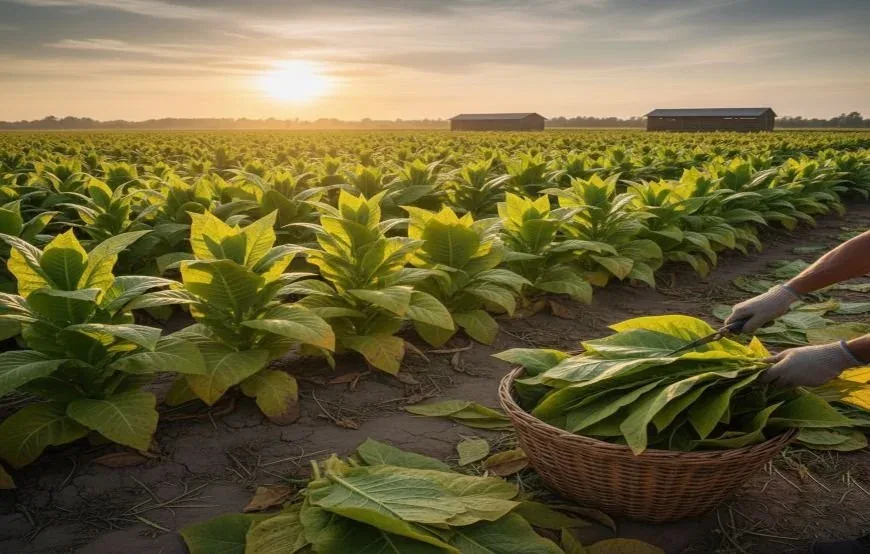
Why Tobacco Harvesting Timing Matters for Leaf Quality and Factory Output
Tobacco harvesting timing is one of the most consequential decisions in the entire tobacco supply chain — made in the field months before the leaf arrives at a cigarette factory, yet directly affecting primary processing performance and cigarette making machine output quality. Harvest timing determines the leaf’s sugar content at the moment of curing, its physical integrity during handling, and its consistency across a batch. Leaf harvested too early lacks the chemical development needed for quality curing and blend contribution. Leaf harvested too late has begun post-maturity deterioration — producing brittle, fragile leaf that generates excess dust in primary processing and creates feed flow inconsistencies at the cigarette maker. For factory buyers, understanding what correct harvest timing produces — and what early and late harvesting look like in factory processing data — is part of managing incoming leaf quality intelligently.
Why Harvest Timing Affects Leaf Chemistry
Tobacco leaf chemistry is not static during the growing season — it changes continuously as the plant develops. Starch content peaks before maturity and then converts progressively to sugars as the leaf reaches physiological ripeness. Nicotine content builds through the growing season and stabilizes at maturity. Aromatic compounds — the precursors that develop during curing and fermentation — reach their highest concentration at full leaf maturity.
Early harvest — before full maturity: The starch-to-sugar conversion is incomplete. The leaf contains higher starch and lower sugar than a fully mature leaf of the same variety. When flue-cured, high-starch Virginia leaf does not develop the high sugar content that defines quality flue-cured tobacco — producing leaf with reduced sweetness and a harder, less favorable flavor profile in the finished cigarette. For Burley, early harvest produces leaf with lower nicotine content than the variety’s potential — reducing its contribution to blend strength.
Correct timing — full maturity: Sugar content is at the variety’s target level. Nicotine is stabilized. Aromatic precursors are fully developed. Physical leaf structure is at maximum flexibility and lamina integrity — the leaf handles well during stripping and cutting without excessive breakage or dust generation.
Late harvest — post maturity: Sugar content begins to decline as post-maturity chemical changes convert sugars into less desirable compounds. The leaf lamina becomes progressively more brittle as the cell structure loses flexibility. Physical handling of over-mature leaf generates significantly more dust in primary processing — dust that contaminates the cut filler blend and creates feed flow problems at the tobacco feeder and garniture section of the cigarette maker.
Tobacco Leaf Maturity Indicators — What to Look For
Commercial tobacco growers assess leaf maturity by visual and tactile observation rather than calendar date — because growing conditions vary between seasons and leaf maturity at a given calendar date is not consistent year to year. The following table covers the five key maturity indicators and what each means for harvest timing and factory processing.
| Maturity Indicator | What It Signals | Harvest Decision | Factory Implication |
|---|---|---|---|
| Slight yellowing at leaf tip and edges | Full maturity — starch-to-sugar conversion complete | Ideal timing — begin priming this position | Correct sugar content — normal curing and blend behavior |
| Thick, firm lamina with slight oily feel | Sugar development complete | Proceed — prime this leaf position | Good physical integrity — normal processing |
| Deep uniform green — no tip yellowing | Immature — conversion not complete | Delay — allow further development | Low sugar, harsh chemistry — affects blend quality |
| Yellowing beyond tip — whole leaf yellowing | Over-mature — sugar degradation beginning | Urgent — prime immediately or accept quality loss | Brittle leaf — excess dust in primary processing |
| Brittle, dry texture | Over-mature — leaf structure deteriorating | Too late — quality loss is irreversible | Physical breakage — high dust, poor cut quality |
Priming — Harvesting in Stages for Consistent Batch Chemistry
Commercial tobacco harvesting uses the priming method — picking mature leaves from the bottom of the plant first and working upward as each leaf position reaches full maturity over several weeks. The scientific basis for priming is that leaf maturity is not uniform across the plant. Lower leaves (called lugs) mature first, followed by cutters, leaf, and tips. Each leaf position has different chemical composition, physical structure, and optimal harvest timing. For a complete explanation of the priming method and how it connects to tobacco farming techniques, see our guide to Tobacco Farming Techniques: Traditional Methods and Modern Practices.
Why priming matters for factory processing: Priming ensures that each batch harvested in a single priming round consists of leaves at the same maturity stage — producing a batch with consistent chemical composition. A batch of leaves all harvested at the correct timing produces consistent sugar content, consistent nicotine level, and consistent physical structure. This consistency is what allows factory primary processing to achieve stable cut filler quality from the batch — predictable blend behavior and stable cigarette making machine performance.
What happens when priming is skipped: If the entire plant is cut at one time — harvesting all leaf positions simultaneously — the resulting batch contains leaves at radically different maturity stages. Lugs that are over-mature, leaf that is at peak maturity, and tips that are immature all mix together in a single batch. This mixed-maturity batch produces highly variable chemical composition and physical structure — requiring more aggressive conditioning in primary processing and producing blend inconsistency that cannot be fully resolved downstream.
Weather Conditions During Harvest
Ideal harvest conditions: Dry, mild weather — no rain in the 24 hours before harvest. Dry leaf surfaces prevent the moisture uptake during cutting that can encourage mold development in early curing stages. Mild temperatures — 15 to 25 degrees Celsius — allow harvested leaves to maintain their physical integrity during the hours between picking and hanging in the curing barn.
Harvesting in rain or high humidity: Wet leaf surfaces at the time of harvest introduce surface moisture that is carried into the curing barn — slowing the early drying phase of flue curing or air curing. High surface moisture also increases mold risk during the first days of curing before moisture levels drop below the threshold for microbial activity.
Harvesting in extreme heat: Harvested leaves transpire rapidly in high temperatures — losing moisture more quickly than the plant tissue can accommodate. Rapid moisture loss after harvest causes premature wilting that can stress the leaf cell structure and affect curing quality. Where possible, harvesting during cooler morning hours reduces heat stress on harvested leaf.
How Harvest Timing Affects the Full Processing Chain
The effects of harvest timing carry through every subsequent stage of leaf processing — from curing through fermentation, aging, and into factory primary processing. Well-timed harvests at full maturity produce leaf that responds correctly to each subsequent processing stage — curing efficiently, fermenting predictably, and conditioning consistently in factory primary processing. For a complete guide to how the full leaf processing chain connects from harvest through factory production, see our guide to How the Tobacco Production Process Works Step by Step.
Frequently Asked Questions
Why does tobacco harvesting timing matter for factory processing?
What does immature tobacco leaf look like at harvest?
What happens to over-mature tobacco leaf in factory processing?
Why is the priming method better for factory leaf quality than whole-plant cutting?
Conclusion
Tobacco harvesting timing is an upstream quality control decision that shapes every subsequent stage of leaf processing — and ultimately the consistency of cigarette production at the factory. Full maturity harvesting at the correct leaf position, using the priming method under appropriate weather conditions, produces leaf with the chemical composition and physical integrity that downstream processing — curing, fermentation, conditioning, and primary processing — depends on. Factory buyers who understand what correct and incorrect harvesting looks like in their incoming leaf quality data can identify timing problems early and communicate clearer specifications to leaf suppliers. For a complete guide to leaf quality from the tobacco plant through to the cigarette making machine, see our guide to What Is Tobacco Filler and How It Shapes Cigarettes. For tobacco machinery suppliers in USA who supply primary processing equipment, see our dedicated suppliers page.



Looking for Cigarette Machinery?
Browse our current inventory of manufacturing, filter making, packing, and wrapping equipment, or send us your target speed and format for a fast quote.