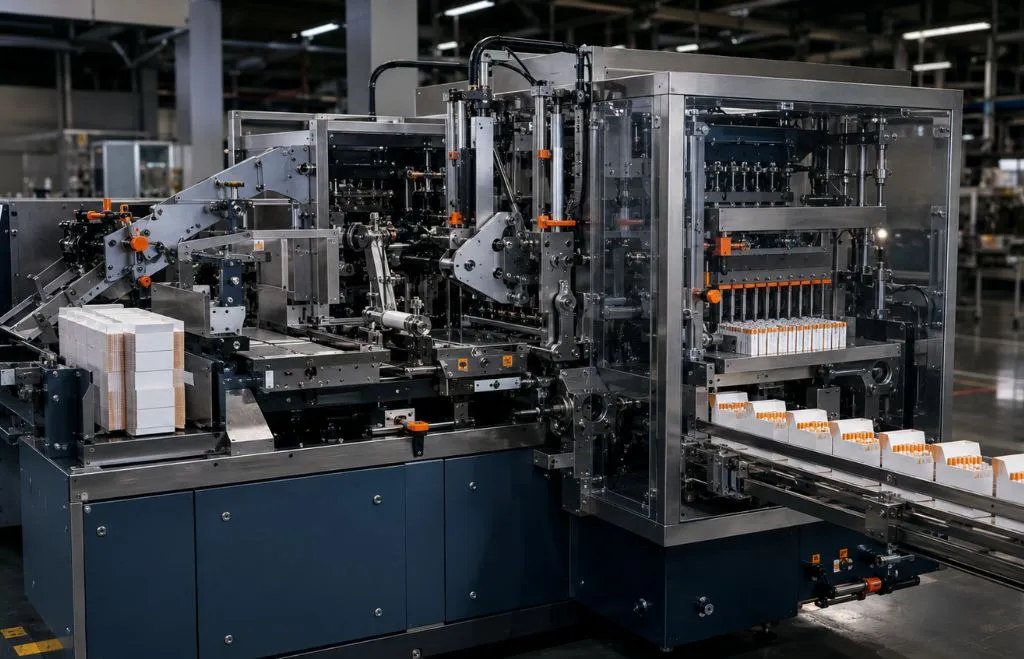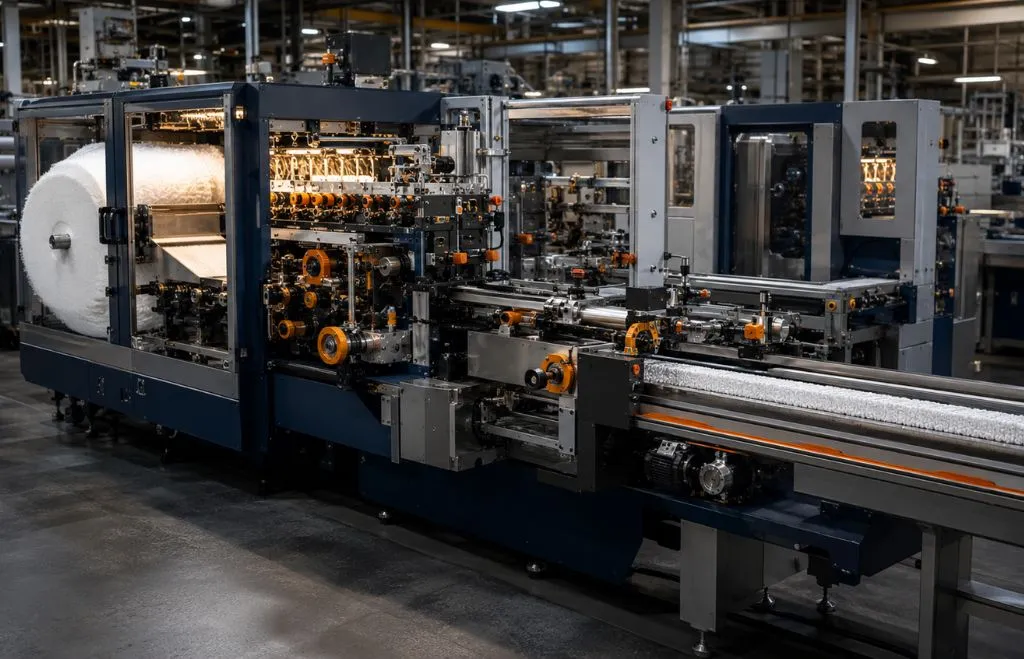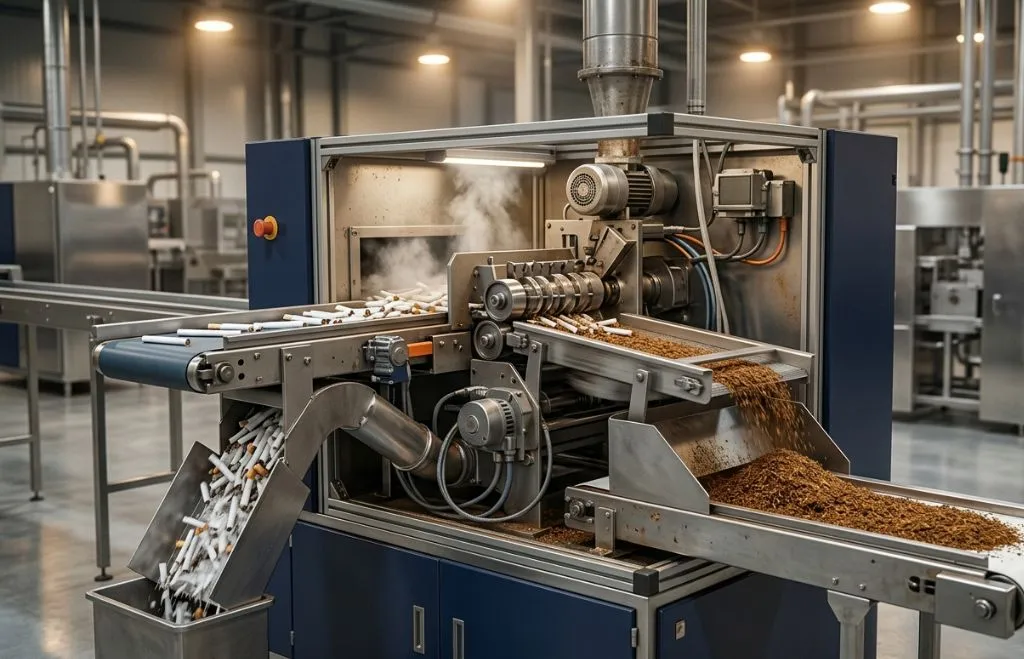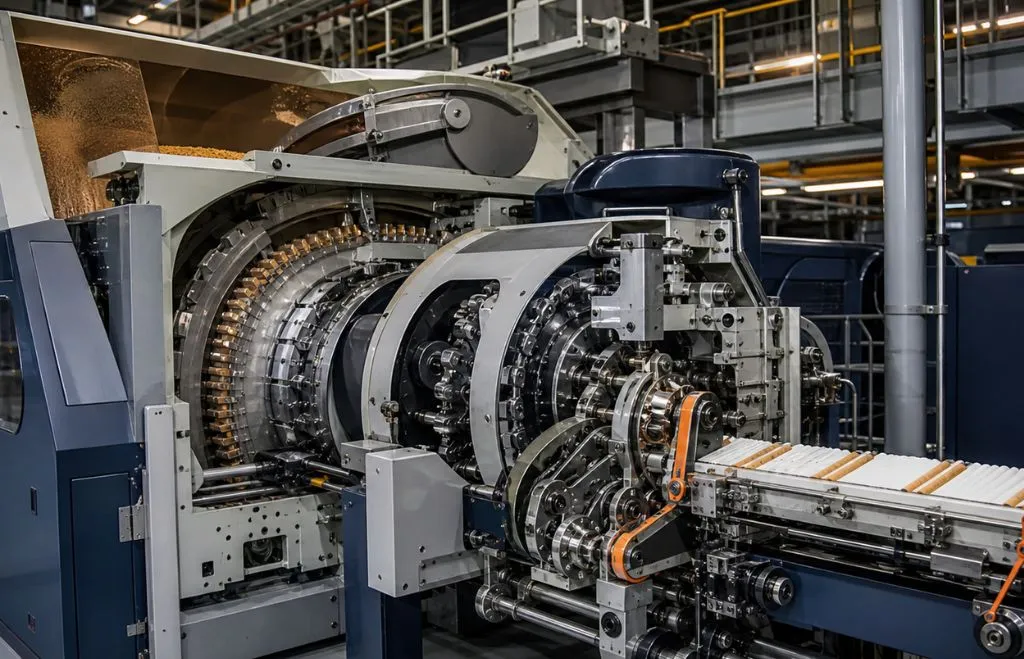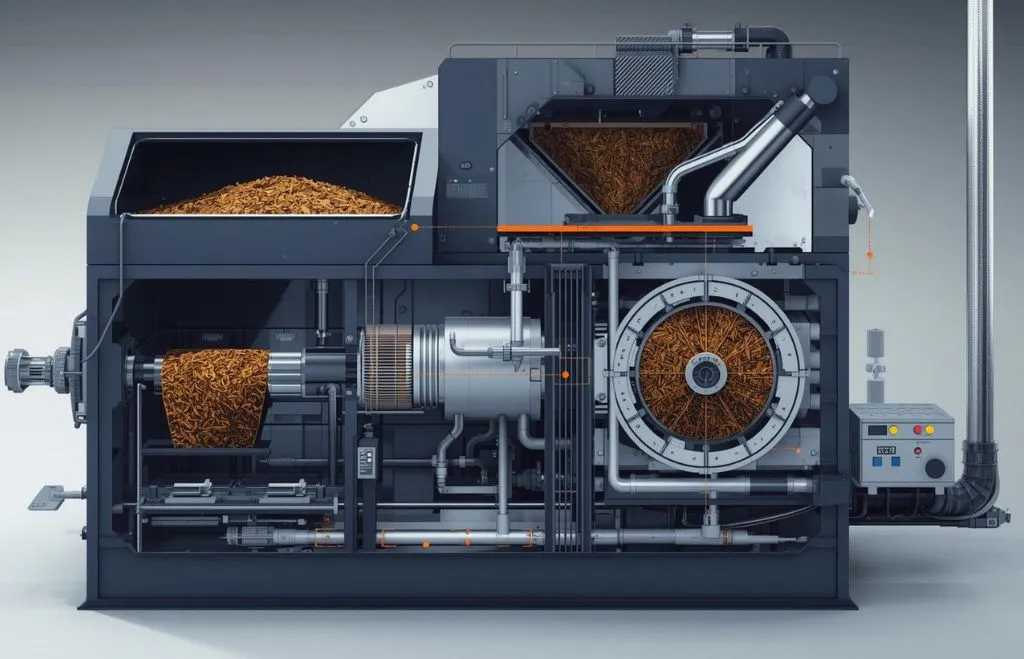
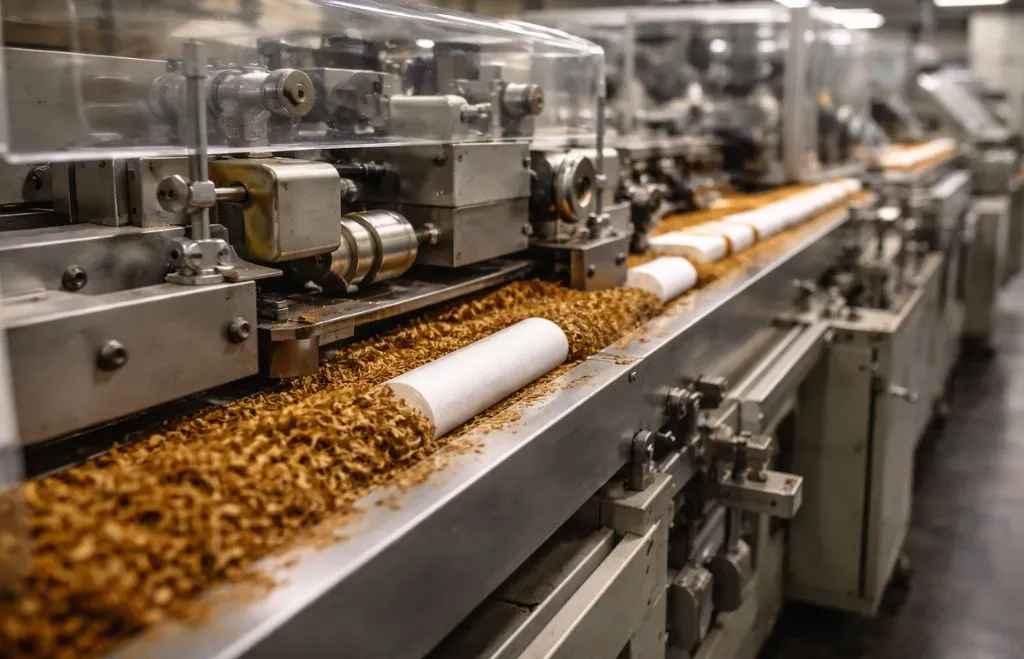
Understanding how a cigarette making machine works requires following tobacco through the machine from the moment it enters the feeder hopper to the moment finished filter cigarettes exit into the output tray — a 7-stage automated process that runs continuously at speeds from 2,000 to 12,000 cigarettes per minute depending on the platform. At 7,000 cpm on a Körber Protos 70, the machine produces 117 finished filter cigarettes every second. Every stage in the process must work correctly and consistently — because at that speed there is no opportunity for manual correction between stages.
The Two Sections of a Cigarette Making Machine
Every commercial cigarette making machine — whether a Molins Mark 8, Mark 9, or Körber Protos platform — consists of two integrated sections working as one synchronized system. The first section is the cigarette maker — where the tobacco rod is formed, wrapped in paper, sealed, and cut. The second section is the filter tip assembler — where filter rods are attached to cigarette rods using tipping paper to produce finished filter cigarettes. On Molins platforms the filter assembler is a Hauni unit — Max 3 on the Mark 8, Max S on the Mark 9. On Protos platforms it is the M8000 unit. For full platform specifications, see our What Is a Cigarette Making Machine guide.
How a Cigarette Making Machine Works: 7 Stages
Stage 1 — Tobacco infeed from feeder system: Cut tobacco filler is delivered from the tobacco feeder hopper to the garniture section at a controlled feed rate matched to production speed. The PLC-controlled feeder adjusts delivery rate continuously using feedback from the weight control sensor. At 7,000 cpm the feeder delivers approximately 490 meters of continuous tobacco rod worth of material every minute. Any surge or shortage in feed flow creates an immediate weight deviation in the rod being formed at that moment.
Stage 2 — Tongue distribution: Before the tobacco reaches the garniture tape it passes under the tongue — a fixed wedge-shaped guide that spreads the incoming tobacco stream evenly across the full width of the forming section. The tongue controls how tobacco is distributed across the rod cross-section from left to right. Even 1mm of tongue misalignment produces uneven tobacco distribution that creates draw resistance variation in every cigarette produced — a quality problem that cannot be corrected downstream.
Stage 3 — Garniture tape compression and paper wrapping: This is the core of the process. The garniture tape — a continuous loop running the length of the forming section — wraps around both the tobacco and the cigarette paper simultaneously. As the tape carries both through the forming section it applies progressive compression that shapes the tobacco into the cylindrical rod form. The tape simultaneously carries the paper beneath and around the tobacco — wrapping the paper around the rod as compression is applied. The garniture tape determines rod circumference, density, and surface quality. It is the highest-wear component in the machine — it must be replaced at the manufacturer’s specified interval regardless of visual appearance.
Stage 4 — Seam sealing: As the continuous paper-wrapped rod exits the garniture forming section, hot melt adhesive is applied to the paper seam by the seam glue system. The nozzle applies adhesive precisely along the paper seam edge as the rod travels past at production speed. The adhesive bonds the paper closed around the tobacco rod — creating a structurally sealed cylinder that holds together through cutting, filter attachment, and handling. A partial or failed seam seal causes rod break-outs at the cutter where the rod opens under cutting stress.
Stage 5 — Cutting: The sealed continuous rod is cut into individual cigarette lengths by precision blades mounted on a rotating cutting drum. The cutting drum rotates at a speed precisely synchronized with the rod travel speed — ensuring every cut produces a rod of exactly the specified length. The synchronization between rod speed and cutting drum speed is controlled by the machine’s PLC system. Worn cutting blades produce ragged cut ends — the torn tobacco at the rod tip contaminates the tipping drum surface in the filter assembler and causes filter attachment misalignment.
Stage 6 — Filter attachment: Individual cigarette rods pass to the filter tip assembler — the second major section of the machine. The filter assembler receives filter rods from the upstream KDF filter making machine. At the tipping station, one filter rod is placed end-to-end with one cigarette rod, tipping paper is wrapped around the combined junction point, and the double-length combined unit is cut in half to produce two finished filter cigarettes. The entire sequence operates synchronized with the maker at production speed — the filter assembler processes exactly as many filter rods per minute as the maker produces cigarette rods. Ventilation lasers in the filter assembler section create the perforations in filter tips and tipping paper required for ventilated cigarette specifications.
Stage 7 — Quality detection and tray filling: Every finished filter cigarette passes through the quality control detection system before reaching the tray filler. Sensors detect defective cigarettes — air leakage, loose end, missing filter, soft spots, hard spots, underweight, overweight — and eject them automatically from the production stream without stopping the machine. On the Protos 70 the system detects 7 defect parameters continuously at full production speed. Cigarettes that pass quality control are deposited into standard output trays by the automatic tray filler — the Mass Flow Tray Filler on Mark 9 platforms, the F80 Auto Tray Filler on Protos platforms — without stopping the machine for tray changes.
Key Components and What Happens When They Wear
Understanding which components wear fastest and what quality problems each causes is essential for production engineers managing cigarette making machine performance.
| Component | Function | Wear Rate | Impact if Worn |
| Garniture tape | Compresses tobacco into rod shape — defines circumference and density | High — primary wearing part | Circumference variation — weight variation — draw resistance problems |
| Tongue | Distributes tobacco evenly across garniture width | Low — alignment issue not wear | Uneven tobacco distribution — draw resistance variation |
| Suction band | Holds tobacco against paper before garniture compression | Medium | Rod break-outs — tobacco falls before seam seals |
| Seam glue nozzle | Applies hot melt adhesive to seal paper seam | Medium — blockage risk | Open seam — rod break-outs at cutter |
| Cutting blades | Cuts continuous rod into individual cigarette lengths | High — regular replacement | Ragged cut ends — filter attachment problems downstream |
| Filter tip assembler drums | Holds and transfers cigarette and filter rods for tipping | Medium | Filter misalignment — tipping paper defects |
| Weight control sensor | Monitors rod density — sends correction signal to feeder | Low — calibration drift risk | Incorrect feed rate corrections — weight drift undetected |
How the Machine Maintains Quality Automatically
Closed-loop weight control: The weight control sensor — microwave-based on the Protos 80 ER, optional on Mark 9 and MK8D — monitors rod density continuously and sends correction signals to the tobacco feeder when weight deviates from the setpoint. The PLC adjusts the feeder rate in real time — correcting weight drift before significant numbers of out-of-specification cigarettes are produced.
Automatic quality rejection: The quality detection system operates continuously at full production speed. When a defective cigarette is detected, the system triggers a rejection actuator — typically a pneumatic cylinder — that diverts the defective cigarette from the production stream before it reaches the tray filler. The rejection mechanism operates in milliseconds — the machine does not slow or stop for individual cigarette rejections.
PLC fault management: The PLC monitors all machine axes, sensors, and safety systems continuously. When a fault is detected — drive overload, sensor failure, safety circuit activation, seam glue temperature deviation — the PLC stops the relevant machine section, displays the fault code on the operator panel, and logs the fault with a timestamp. The fault log builds a production history that allows engineers to identify recurring fault patterns and their root causes.
For a complete guide to all seven automation systems that enable this level of continuous quality management, see our How an Automatic Cigarette Maker Works guide.
How Speed Affects the Process
The 7-stage process described above runs at the same sequence regardless of platform — what changes with speed is the precision and response time required from every component.
- At 3,000 cpm (Mark 8 MK8D) — the cutting drum makes 50 cuts per second. Any blade wear or synchronization error affects 50 cigarettes per second
- At 5,500 cpm (Mark 9) — the filter assembler handles 92 filter attachment operations per second. Tipping drum surface wear affects quality immediately at this rate
- At 7,000 cpm (Protos 70) — the garniture tape moves at 490 meters per minute. Any tape wear or tension variation affects 117 cigarettes per second
- At 8,000 cpm (Protos 80 ER) — the microwave weight sensor monitors 133 rods per second and sends a correction signal to the feeder before the next deviation compounds
- At 12,000 cpm (Protos M5) — approximately 370 sensors monitor 200 cigarettes per second — requiring AI-assisted fault detection to process the volume of sensor data generated
For a complete comparison of how speed tier determines platform selection, see our High Speed vs Mid Speed Cigarette Machine guide.
Maintenance Priorities for Consistent Machine Performance
- Every shift: Sample 10 cigarettes — check weight, circumference, draw resistance and cut end quality. Check seam seal by pulling paper seam on sample rods
- Every week: Check garniture tape tension and surface condition. Clean seam glue nozzles. Check suction band condition and suction pressure. Inspect tongue alignment. Inspect filter assembler tipping drum surfaces
- Every month: Calibrate weight control sensor. Full garniture tape inspection — replace if at wear limit. Replace cutting blades. Verify PLC setpoints against current product specification
- Every quarter: Replace garniture tape regardless of visual condition. Full cutting drum inspection. Full filter assembler cam wear inspection. Verify all quality detection sensors against calibration standards
Frequently Asked Questions
How does a cigarette making machine work?
A cigarette making machine works through 7 stages: tobacco is delivered from the feeder to the garniture section where it is distributed by the tongue and compressed by the garniture tape, wrapped in cigarette paper, sealed with hot melt adhesive, and cut into individual lengths. The filter tip assembler then attaches filter rods using tipping paper. Quality control sensors detect and reject defective cigarettes, and the tray filler deposits finished cigarettes into output trays automatically.
What is the garniture section and why is it important?
The garniture section is the rod-forming core of a cigarette making machine — where tobacco is compressed into rod shape by the garniture tape, wrapped in paper, and sealed. It is the most critical section for cigarette quality because rod circumference, density, draw resistance, and surface quality are all determined here. The garniture tape is the highest-wear component — worn tape produces circumference variation, weight variation, and draw resistance problems simultaneously.
How does filter attachment work on a cigarette making machine?
Filter attachment works in the filter tip assembler — the second major section of the machine. Filter rods from the upstream KDF filter making machine are placed end-to-end with cigarette rods from the maker. Tipping paper is wrapped around the combined junction point, and the double-length unit is cut in half to produce two finished filter cigarettes. The filter assembler operates fully synchronized with the maker at production speed — processing exactly as many filter rods per minute as the maker produces cigarette rods.
How does quality detection work on a cigarette making machine?
Quality detection sensors monitor finished filter cigarettes continuously at full production speed — detecting air leakage, loose ends, missing filters, soft spots, hard spots, underweight cigarettes, and overweight cigarettes. When a defective cigarette is detected, a pneumatic rejection actuator diverts it from the production stream in milliseconds without stopping the machine. The Protos 70 detects 7 defect parameters. The Protos M5 monitors approximately 370 sensor parameters using AI-assisted detection.
Why does garniture tape wear cause quality problems?
The garniture tape determines three quality parameters simultaneously — circumference, density, and surface quality. A worn tape applies inconsistent compression across its length — some sections of the rod end up wider or narrower than specification, some sections are over-compressed producing high draw resistance, others are under-compressed producing low draw resistance. Garniture tapes should be replaced at the manufacturer’s specified interval regardless of visual appearance.
Conclusion
How a cigarette making machine works is a 7-stage process that must run precisely and continuously at speeds where human monitoring and correction are impossible — which is why component condition, calibration, and scheduled maintenance are the primary determinants of production quality and efficiency. Production engineers who understand what each stage does, what each component controls, and how wear affects quality are significantly better positioned to maintain consistent output and reduce rejection rates across the production shift. For a complete guide to what a cigarette making machine is, the main platform types, and how to choose between them, see our What Is a Cigarette Making Machine guide. For tobacco machinery suppliers in USA who supply cigarette making machines and components, see our dedicated suppliers page.